

Hello You,
For the last few months, we have been delivering musical terms for you to devour and playlists too.
A mini education, SongsBrew style.
Now it is pop quiz time.
If you have recently subscribed, all the reference posts are linked so you can catch up, and you can have an honorary pass - congrats!

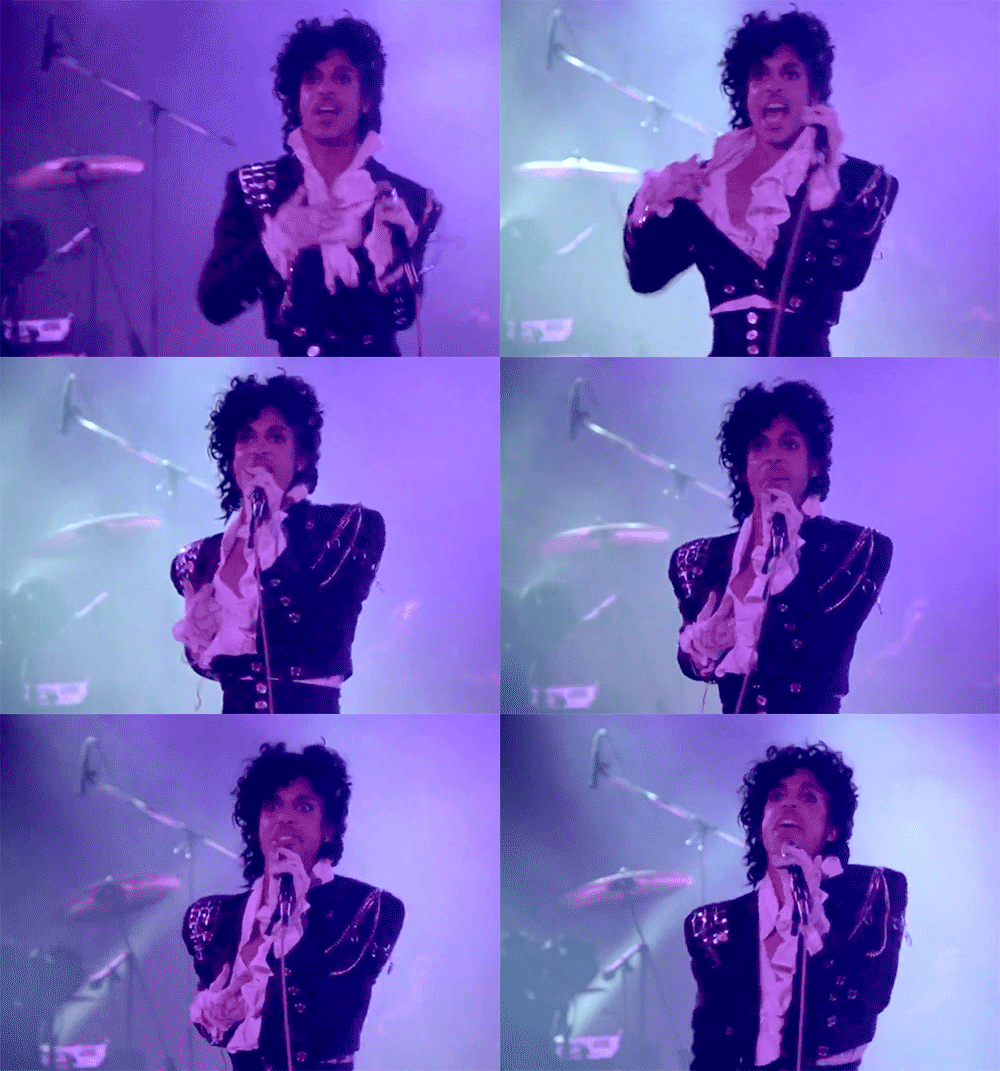
Gif by molotowstpauli on Giphy
SongsBrew Editorial
The Studied Ear.
Over the last few months, SongsBrew (us) have been running an unofficial curriculum. Flow pockets. Headroom. Silence. Dissonance. Sidechain. Hallucination. All of those good bits of music, that sometimes we can’t find the words to describe. Most of the time we don’t know the words or the how, but we know the feeling. We’ve had a lot of fun doing it, and we’re already looking for more.
However before that, this week, we find out if you were paying attention.
Ten questions. Three options each. Read the question, pick your answer, then scroll down for the reveal. Keep score as you go. Results at the bottom.
Q1 — Flow Pocket
At 90 BPM, a pocketed rapper sits how far behind the grid?
A. +/- 5ms — barely noticeable, tight as a drum machine
B. +/- 30ms — the pocket lives here
C. +/- 166ms — one full sixteenth note gap
B. +/- 30ms. At 90 BPM, the gap between sixteenth notes is 166ms. The pocket lives in roughly 30ms of that. Which doesn't sound like much. And isn't.
J Dilla turned quantize off entirely on his MPC3000 and played the drums in by hand. His snares sat 30-50ms behind. His kicks often sat ahead. And somehow that was the most grooved thing anyone had ever heard. Anything much past 50ms and you're not pocketed, you're just late. There's a difference. Read: Disgusting Flow Pocket
Hear it: DONUTS, J Dilla
Gif by rokkr on Giphy
Q2 — Flow Pocket
What is the difference between late and pocketed?
A. Late is always at higher BPMs. Pocket is a slower tempo thing.
B. A pocketed rapper drifts - sometimes ahead, sometimes behind.
C. A pocketed rapper picks an offset and holds it, bar after bar. A late rapper drifts.
C. Late is an accident. Behind the beat is a decision.
The tell is consistency. A pocketed rapper picks an offset and holds it, through pace changes, through everything. Strip the beat from a Pusha T verse and the internal rhythm is still there, completely intact. Strip it from a sloppy rapper and you'll hear someone rushing and dragging (if you know our fave film, you’ll know this reference) with nothing to hold onto. One is operating their own private grid. The other is just late. These are very different things. Read: Disgusting Flow Pocket
Hear it: DNA, Kendrick Lamar
Q3 — Crushed Headroom
You turn up a crushed record. What happens?
A. It gets louder and the dynamic range comes back.
B. The streaming platform compensates and re-adds the headroom.
C. It gets louder. The dynamic range does not come back.
C, unfortunately. Volume is the knob you have. Loudness is baked into the recording. Turn a crushed record up and it gets louder. It does not get better. It cannot get better.
16,000 fans signed a petition asking Metallica to remix DEATH MAGNETIC. Badly brickwalled, genuinely difficult to listen to. The band shrugged. Those same tracks on the Guitar Hero III disc? Sounded enormous. Because the game used a less compressed version. Fans ripped it and shared it. The lesson was not learned. Read: Crushed Headroom
Hear it: DEATH MAGNETIC, Metallica
Q4 — Crushed Headroom
Spotify's target LUFS is...
A. -6 LUFS
B. -23 LUFS
C. -14 LUFS
C. -14 LUFS. Spotify -14. Apple Music -16. Amazon -14.
You can master as loud as you like. The platform turns you back down anyway. Every record that sacrificed dynamic range to be louder on a CD now sounds the same as everything else on streaming, except worse, because the transients are gone. Bands gave up the thing that made the music feel alive. For nothing. Read: Crushed Headroom
Hear the headroom: LATERALUS, Tool
Q5 — An Obscene Sustain
What is melisma?
A. The notation symbol for a note held beyond its written duration.
B. The vibrato technique used in gospel vocals.
C. Multiple pitches on one syllable.
C. Multiple pitches on one syllable. And A is the fermata.
Melisma is the technique, the approach road to the obscene note. Gospel built it. Mahalia Jackson to Aretha to Cissy Houston to Whitney. A straight line. Bill Withers held a single note for 18 seconds on LOVELY DAY. Chester Bennington held one for 17/18 seconds on GIVEN UP and dropped octaves while doing it without reducing force. Read: An Obscene Sustain
Hear it: I WILL ALWAYS LOVE YOU, Whitney Houston
Gif by BournemouthUniversity on Giphy
Q6 — Fermata
What does a fermata tell a performer?
A. Hold the note for exactly twice its written value.
B. Hold the note beyond its written duration. No fixed length — the performer decides.
C. Rest in silence for as long as feels right.
B. No fixed length. The performer decides.
Not a set amount. Just: hold until it's done. The fermata is where the human takes over from the score. When a live singer holds it longer than the recording, they are not going rogue. They are reading the room, or as we see it, delivering the music as they wanted it to be heard. John Cage's 4'33" is technically one long fermata on silence. Miles Davis said it's the notes you don't play. Dead air isn't the wait for the good part. It's part of the good part. Read: Fermata
Hear the silence: BLUE IN GREEN, Miles Davis
Q7 — Sidechain Breathing
At 128 BPM, where should the release be set to make the swell return just in time for the next kick? (yeah, a tough one!)
A. 50ms
B. 469ms — the full beat interval
C. 250-350ms
C. 250-350ms. And the release is the whole feeling.
At 128 BPM there are 469ms between beats. Set the release at 250-350ms and the ducked sound swells back just before the next kick pushes it down again. That swell is the exhale. Too fast and it snaps back. Too slow and it misses. deadmau5 took this further and sidechained to a ghost kick, a kick that is completely silent, existing only to trigger the compressor. The track breathes around a drum you can’t even hear. That is a very cool trick. Read: Sidechain Breathing
Hear it: LET IT HAPPEN, Tame Impala
Q8 — A Twong Not A Twang
Medieval theorists called it 'diabolus in musica' — the devil in music. What interval is this?
A. The minor second - two adjacent semitones.
B. The tritone - three whole tones, diminished fifth or augmented fourth.
C. The major seventh - one semitone below the octave.
B. The tritone. The devil in music. And it really did get called that.
Three whole tones. Medieval theorists called it diabolus in musica and banned it from sacred composition because it sounded morally threatening. Jimi Hendrix built PURPLE HAZE on it, because why not. Black Sabbath opened their entire career on the first note of their first song on their first album with it - which is a very Sabbath thing to do.
Hear it: BLACK SABBATH, Black Sabbath
Q9 — Involuntary Hallucination
You are hearing bass on a phone speaker. Where is the bass actually coming from?
A. The phone generates sub-bass through its amplifier chip.
B. Streaming platforms add a bass enhancement layer before delivery.
C. Your auditory cortex calculates the missing fundamental from the harmonics above it.
C. You are the bass.
The speaker produces the harmonics above the fundamental, 200Hz, 300Hz, 400Hz and up. Your auditory cortex finds the pattern, calculates the missing frequency, and generates the note that isn't there. J.F. Schouten described this in 1940. Licklider confirmed it in the 1950s, after discovering that a phone that cut everything off below 340Hz could still reproduce a man's voice clearly. The fundamental was missing. The brain just made it up anyway.
You have been hallucinating bass your entire listening life and probably thought your phone sounded decent. Read: Involuntary Hallucination
Test it: ARCHANGEL, Burial. Play it on your phone speaker. The bass that shouldn't be there, is there.
Q10 — The Full Syllabus
D'Angelo's Voodoo is 78 minutes of what?
A. Crushed headroom - the whole record is brick-walled.
B. Pocket - the most pocketed record ever made (in our opinion, but we’re happy to hear more, and we know that gives away the answer).
C. Fermata - silence used as a compositional device throughout.
B. Pocket. Obviously.
78 minutes of the most considered groove ever put on record. Not headroom, it's beautifully mastered actually. Not fermata, though the silence is used well. Pocket. D'Angelo breathes at his own pace, not the song's. Every note he holds opens into the next one. Questlove plays with so much internal swing the grid basically dissolves. If you try to find the click, you cannot. We have tried. Many times.
We will die on this hill. Read: Disgusting Flow Pocket
Hear it: VOODOO, D'Angelo. Start with UNTITLED (HOW DOES IT FEEL) and try to find the grid. You won't.
Giphy
How did you do?
10/10 — First Class. You have been paying attention. You have the ears and the vocabulary. Congratulations, graduate.
8-9/10 — Honors. Strong. A couple of gaps but your ears are well trained. Go back and read the ones you missed.
6-7/10 — Pass. You know more than most. But there are some lessons you skimmed. Go back. Read them properly this time.
4-5/10 — Retake Required. You are retaining some of it. But not enough. The back catalog is waiting.
0-3/10 — Start Over. Go back to Disgusting Flow Pocket and work forward. We believe in you.
Stay tuned for some excellent stuff coming in the next few weeks. Community threads where you can share playlists and what you are listening to, music setups, tips and more.
Expect your invitation very soon.
Log in or subscribe to comment