


Hello You,
Last week we went deep into sleeper agents. 95+ songs on the (open to join) playlist.
We’re adding songs regularly, and invite you to add some too. Click the playlist image at the bottom of the newsletter to join.
This week, we're staying technical. But it's a different kind of technical.
Not milliseconds this time. Decibels.
What in the LUFS?

Gif by mailchimp on Giphy
SongsBrew Editorial
Crushed
Between 1995 and 2010, we started to see releases that had a loud flatness so dirty and stubborn that turning down the volume didn't even help. Loud and flat at any volume, no matter what you did with the dial - horrible.
You don't find it in a lot of old tracks, and even less so in newer ones.
When it happened, you were in the middle of a Loudness War. It ruined more than a few records. And it didn't matter what you did with the volume control. It pulled your ears places they just weren't meant to go. Not to mention the force blasting through your speakers.
We're in the Headroom.
What is Headroom then?
Think of the headroom like the space between the top of your head and the ceiling. It’s that gap between the loudest point of a track and the point where it starts to clip and distort.
When there is enough space, the loud parts actually feel and sound loud, but without room, there is nowhere to move. It would be like the top of your head touching the ceiling, then going on your tiptoes; you’ll need to tip your head to fit. There is nowhere to go.
If there is no headroom, everything is at the same volume, so the sound wave will look solid rather than the beautiful ups and downs we see on a standard one. Our brains love contrast; we love highs and lows. We’re less good at processing solid walls of sound; it becomes painful and tiresome.

Giphy
Why did that happen then?
Something that vinyl was incredible at was having limits. Loudness on a vinyl is dictated by the grooves. Go and check the groove spacing on a couple of records; wider groove spacing is for a club cut (intentionally loud), and you’ll see less audio per side, too.
You know what doesn’t have that issue? CDs.
So, like with any technology, the challenge became to see how far engineers could master it. The louder the better. Not for our ears, but they don’t matter.
For that span of time, when CDs were the medium of choice, there were more flat tracks than ever. A race to the ceiling began. The problem is you lose a lot of the detailing, the stuff that makes music good.
Here is what that looks like:
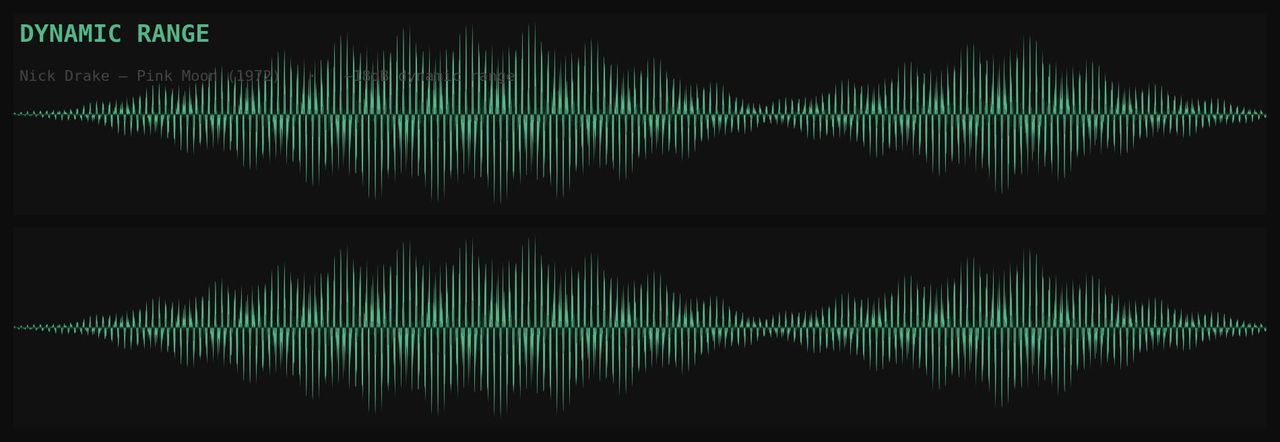
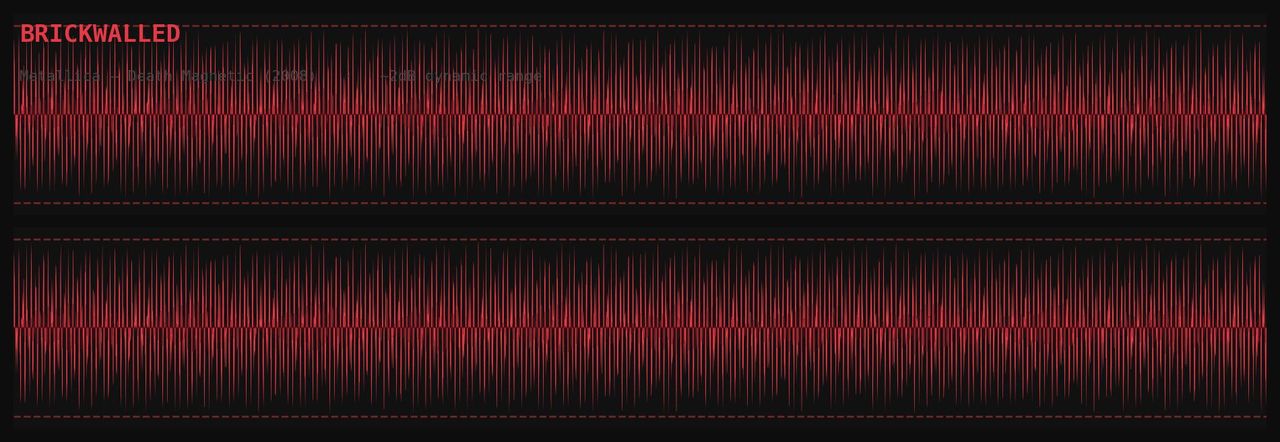
As you might expect, one is flat with very little space, and the other has actual waves.
Death Magnetic
One of the most prominent examples of this Loudness War was the Metallica album Death Magnetic. It was released in 2008, and fans noticed immediately that it was brick-wall compressed and too loud to enjoy at all. Interestingly, this was done in the mix and was flat as a pancake before it got to the mastering engineer, who distanced himself from its distorted sound. The band was cool with the sound, though, so when 16,000 fans signed a petition for a remix or remaster, the band wasn’t bothered.
"I'm not gonna sit here and get caught up in whether [the sound] 'clips' or it doesn't 'clip,'" says Ulrich. "I don't know what kind of stereos these people listen on. Me and James [Hetfield] made a deal that we would hang back a little and not get in the way of whatever Rick's vision was. - Lars Ulrich, interview with Blender September 2008.
But you know where the tracks sounded like they should? Guitar Hero III: Legends of Rock. Fans ripped the sound, shared it, creating their own album. Eventually, a “Mastered for iTunes” and ‘dynamic’ release happened - funny that, maybe it didn’t actually sound great the first time then. The Guitar Hero was the heavy they were looking for, while the CD was just loud.
In the end, it was a semi-pointless pursuit. Because you know who doesn’t care about your need to be loud? DSPs. Amazon keeps its LUFS at a cool -14, Apple Music -16, and Spotify -14.
What are LUFS, you ask?
LUFS stands for Loudness Units Relative to Full Scale. How streaming platforms measure perceived loudness. If your record was mastered loud to compete, the platform just turns it back down to its target.
The loudness war killed the breath in a generation of records for CDs. The platforms reversed the volume anyway - cause they really don’t care. Even an EQ can’t save you most of the time.
Bands gave up dynamic range for nothing.
And while many bands jumped on the loud train to distortionville, a couple opted out completely. And instead made use of this new dynamic opportunity. Radiohead's OK Computer, which avoided loud mastering, was released in 1997; Kid A, in 2000, followed suit. Wilco - Yankee Hotel Foxtrot, huge headroom. Portishead - Third, 2008, the same year as Death Magnetic, full contrast.
For more genre-fitting: Slipknot - Iowa, 2001, the album that got Greg Fidelman the Death Magnetic job, probably because it sounds enormous and has headroom. Mastodon's Crack the Skye (2009) is often used as the counterexample. Tool - Lateralus, 2001, maybe the best mastered metal album of all time?
The reason people loved them more? Headroom. No one needed a petition for remix or remaster.
The technical bits
Volume is the control you have. The knob. The slider. The screen tap. Whatever. How loud your speakers or headphones are playing something back. It is entirely in your hands.
Loudness is baked into the recording itself. It is how much of the available dynamic range a track is using, and how aggressively it has been compressed and limited before it ever reaches your ears. You cannot fix it with your volume control. Turn a crushed record up, and it gets louder. It does not get better, unfortunately.
Headroom - the space between the loudest peak and the clipping point. A well-mastered record keeps 3-6dB before final limiting. That gap is what allows transients to exist.
Transients - the initial spike of a sound. The crack of a snare. The pluck of a string. Your brain reads the transient first, before the sustained note arrives. Crush the headroom, and you crush the transients. The snare stops sounding like a snare.
LUFS - Loudness Units relative to Full Scale. How platforms measure perceived loudness. Master loud to max, the platform turns you back down. Master with dynamic range, the platform turns you up slightly. Either way, the volume evens out. The dynamic range does not come back.
Dynamic range - the difference between the quietest and loudest parts. Most music before 1990 has 12-18dB of it. Most music from the peak of the loudness war has 2-6dB. Your ears can tell. That is why older records feel different (some might say better…)
And when it is all just right? And the record hits that big splash of real loud…

Gif by MadeBySpeak on Giphy
See you next Thursday.

Click to join and add your own sleeper agents (from any era).


Log in or subscribe to comment