

Hello You,
Last week, we talked about listening, a real sit-down with intention stuff.
With the promise to cover the disgusting flow pocket this week.
What does 166ms matter anyway?
Gif by laurenthrybyk on Giphy
Catchy is manufactured, a pocket is summoned
Catchy is the earworm, heavily manipulated to be something you can hum along to and will never forget. Catchy is solved. Anyone with Logic, a vague sense of melody, and 40 free hours can land it. We could probably have a go.
So when catchy gets thrown around as a compliment, it’s like saying something is nice. Anything can be catchy, and anything can be nice.
A disgusting flow pocket, though. A different situation entirely.
What is a flow pocket?
A pocket is the negative space between the kick and the snare. It's measured in milliseconds. It's where a rapper, a singer, an organ player, a sax player, or anyone with a vocal or melodic line decides to land their notes in relation to the drums underneath them.
Drum machines are perfect. Humans are not. The pocket is where that gap stops being a bug and becomes the entire feature.
Get it wrong, the song feels stiff. Reading karaoke energy. Get it right, the whole thing breathes. Get it disgusting, and you find yourself rewinding seven times trying to work out what just happened to your chest.
That's the threshold. Not "catchy". Not "clever". Doing something to us we cannot explain.
Late is not pocket, and we need to clear that up
Some of you will hear a rapper slightly off the beat now and assume disgusting. They might just be late.
The difference is consistency. A pocketed rapper picks an offset and stays there, syllable after syllable, bar after bar. The relationship to the drums is stable, repeating, trustable. A late rapper drifts. Way behind on one bar, slightly ahead on the next. Nothing to lock onto.
Late is an accident. Behind the beat is a decision.
Three tells, if you want to test it on a track this week.
A pocketed rapper sounds the same a cappella as they do over the beat. Strip the drums from a Pusha T verse, and the internal rhythm is still there, intact, completely. Strip them from a sloppy verse, and you'll hear a rapper rushing and dragging with no anchor underneath.
A pocketed rapper holds the offset when they accelerate. Speed up, slow down, switch flows, the relationship to the kick and snare stays in proportion. A late rapper drifts further out the faster they go.
A pocketed rapper recovers on the next syllable. If they need to land on the snare for emphasis, they can, instantly, with no scramble. A late rapper hits a wrong-feeling beat and audibly re-grips the bar to catch up.
In short. Late is an accident. Behind the beat is a decision. The pocket is the difference between a rapper missing the grid and a rapper operating their own private grid in parallel, on purpose, while making it look effortless. Apply the same to sounds; they can sit in the space too.
Things that make a flow pocket disgusting (incoming list)
And we mean disgusting enough for you to make this face:
Giphy
Bassface is the involuntary magical response to something you feel in your bones. A drop, a flow, a cadence you weren’t expecting - all of that good stuff.
Where can you find these flow pockets in the world? Here are some tracks for reference.
J Dilla and his late snare
Half of Dilla's legacy is a deliberate refusal to play the snare on time. Donuts leans like a building that knows what it's doing. The drums sit a few milliseconds behind the grid, your brain registers something is wrong, and your body registers something is right.
This is microtiming. It's the most-copied, least-understood pocket trick in modern music, and the reason mainstream producers have spent fifteen years sounding late instead of Dilla. You’ll see people say it took them a few listens to get used to it.
Subdivision switching, mid bar
Straight eighth notes are mechanical. Triplets are rolling. The disgusting flow pocket pivots between them inside a single bar, so the rhythm itself starts doing melody work.
Listen to Kendrick on "DNA" after the beat switch. Listen to Doechii on "Anxiety". Listen to anyone who has ever made you go wait, what just happened. They didn't change tempo. They changed how time was being divided, and your ears followed because there was no other option.
Rhymes buried inside the bar
Most rappers rhyme at the end of the line. We're trained to hear it coming. The outstanding ones bury rhymes inside the bar, on snare hits, on hi-hat opens, in the gaps between drum patterns where you weren't expecting a word, let alone a multisyllable one.
Black Thought's ten-minute Funk Flex freestyle is the clinic. (If you've never sat through it, clear an evening. This is not background music, and you’ll probably want to rewind it a couple of times.) Pusha T has been doing it for two decades, and people still call him a slow rapper. He has a particular flow and subject matter that have served him well for years.
Breath as percussion
Where a rapper takes air is where the pocket lives or dies. Pusha treats his breath like a hi-hat. Earl Sweatshirt holds a silence until it nearly hurts. Andre 3000 used to inhale in places that broke the song's geometry. Somehow it always landed. Doechii, in the last ten seconds of Denial is a River, " is a great representation.
Ignoring the bar entirely
The rapper sits so deep in the rhythm the bar line stops mattering. A phrase finishes two beats into the next bar. The next one starts on the third sixteenth. They are not riding the beat anymore.
Erykah Badu does this. Lauryn Hill on "Lost Ones" does this. D'Angelo does it for 78 minutes straight on Voodoo, which is, and we will die on this hill, the most pocketed record ever made.
Some of our faves:
Giggs has been the British answer to dragging behind the beat for nearly two decades. His classics sit at 80 to 95 BPM, but his flow feels closer to 70. Half-time over an already slow beat. Talkin Da Hardest is one long argument that the snare is on his time, not the other way around.
Kano is the technical sister piece. Grime is 140 BPM, no mercy, and Kano can flip between full-time 140 and half-time 70 inside a single bar like he's adjusting a radio. Hoodies All Summer is where pocket becomes a decision rather than an accident. P's & Q's is a teenager already understanding rhythm better than most rappers do at forty. There’s a reason so many young rappers give him flowers as often as possible.
Honorable UK mentions, since we are here:
Skepta on "Shutdown". Sits just behind the snare, which is half the reason it is still in heavy rotation.
Ghetts. Technical to the point of being slightly annoying about it, in the best way.
D Double E. The British cousin who sat behind the beat on purpose since the early 00s. The "bluku!" ad-libs punctuate the pocket like a tuned percussion instrument.
Dave when he's not sprinting. We're All Alone in This Together has real pocket discipline in places.
A short, incomplete, and emotionally biased list
The chronically pocketed, in no particular order, with apologies to everyone we forgot:
Black Thought (the reference, full stop). Andre 3000. J Dilla. Q-Tip. MF DOOM (the one who sat behind the beat on purpose). Pusha T. Earl Sweatshirt. Doechii. Kendrick on DAMN. Erykah Badu. D'Angelo. Lauryn Hill. Anderson .Paak. Giggs. Kano. Skepta. Little Simz, when she's locked in (Here, listen to a snippet of her upcoming EP Sugar Girl).
What links them is not speed. Not density. Not technical difficulty (although, no denying it’s hard to get right). It is the willingness to sit somewhere uncomfortable in the rhythm and wait for the rest of us to catch up. They play with time and space like it’s not real, and it gives us a physical reaction.
Gif by rokkr on Giphy
And technically?
We’re glad you asked. The pocket is a feeling, sure, but it is razor-sharp precision. It is timing measured in milliseconds.
At 90 BPM (classic boom-bap territory), there are 666ms between beats and roughly 166ms between sixteenth notes. The pocket lives in a band of about +/-30ms around each grid point.
On the grid (0ms). Quantised. Mechanical. Stiff.
Behind the beat (+10 to +30ms). Laid back. The home of hip-hop, R&B, and neo-soul.
Ahead of the beat (-10 to -30ms). Urgent. Punk, drum and bass, drill.
Past +/-30ms. Now you sound late, rushed, or like a different song entirely - unless you know what you’re doing and you’ve owned it.
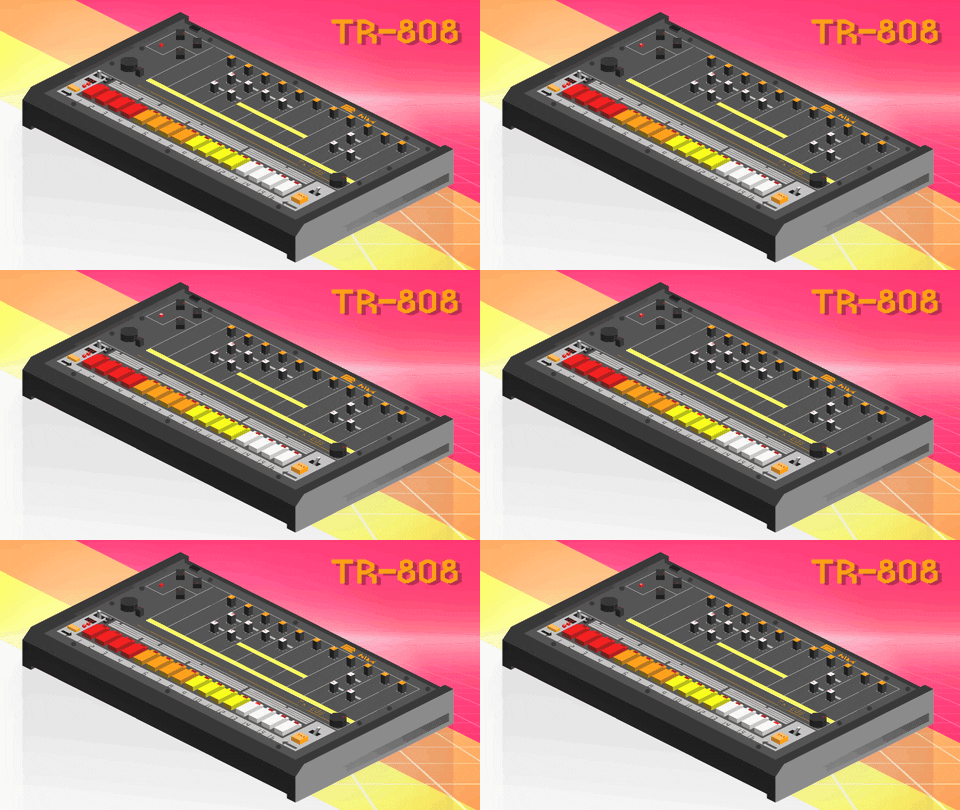
Dilla, famously, turned the quantize off entirely on his MPC3000 and played the drums in by hand. His snares often sit 30 to 50ms behind the grid. His kicks often sit ahead of it. Two hands of the same human pulling the grid in opposite directions, simultaneously, and your ears have to negotiate it in real time.
That asymmetry is the technical heart of disgusting. Anyone can drag a snare. Almost nobody can drag a snare and push a kick and keep a vocal pocketed against both.
Then there's anacrusis. Phrases that begin on the "and" of beat 4 of the previous bar, so the new bar is already three syllables deep before the snare hits. Andre 3000 lives there. Earl Sweatshirt's Some Rap Songs is almost entirely anacrusic, which is why he can sound like he's mumbling and rewarding close listening at the same time.
Now go listen with all of that in your back pocket.
See you next Thursday.
If you made it all the way to here, and we suspect you did, drop a track that has one of the best flow pockets in your opinion, or just something you’re listening to lately.

Log in or subscribe to comment