


Hello You,
Last week we took a look at… nothing. Well, the nothing that is built into a song, 10 points if you can remember the term.
This week, we’ve been hunting out the underused confusion note. The one that shouldn’t be there, but it is, and the song wouldn’t be the same without it.

Gif by juanbilly on Giphy
SongsBrew Editorial
A twong, not a twang
When you're at a live show, a bum note is typically something you expect. Because truthfully, live music isn't going to sound like studio, and it shouldn't either. But what about when the bum notes are put in on purpose on a recording?
There has been a rise in artists who deliberately crack their voices on higher or longer notes. It gives grit, texture, and a sense of humanness. And we love it.
But what about when it happens, say, on a bass? Or a guitar? Or a piano?
Some of it feeds back into what we spoke about a couple of weeks ago, our brains love patterns and love to be wrong sometimes, too. Does a purposely (or accidentally) off-key note have the same impact?

Gif by starwars on Giphy
He asked her for her name, and she said blah blah blah... Biz Markie. The chorus of JUST A FRIEND. Appallingly perfect. Sounds like a night at the karaoke.
More subtle and subject of much conversation, VISIONS OF JOHANNA, Bob Dylan. The official 1966 recording has missed notes, flat notes, missed cues, and weaving vocals. Unintended, apparently, yet it has been interpreted as fitting the lyrical content.
Two Pavement songs, RANGE LIFE and STEREO, need to be mentioned here. Nothing about STEREO sounds like you think it should. Chords outside the keys, some rush, some drag, some what is going on? Strong attitude of anti-precision, completely on purpose.
Now we're coming to a firm favorite. King Gizzard and the Lizard Wizard. They're not on the playlist because they removed everything from Spotify. In RATTLESNAKE and many of their other works, they are using modified instruments. The added frets so they had more than just the Western half-steps. But, to be honest, the harmony starts hitting odd notes around 4 minutes, and some zurna. All intentional. All, a little bit off.
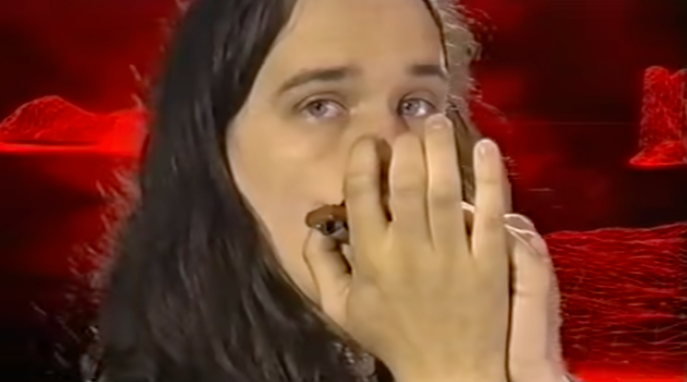
Click for a trippy YouTube video.
And a bass that will either sound great to you, or horrific, is AROUND THE WORLD - Red Hot Chili Peppers. If you can get beyond the ding, ding, ding, dong in the first place.
Playlist at the bottom, with a couple of extra tracks we haven't gone into.
The Science of Wonk
The technical term for the clash between two notes that resist resolution is dissonance. Western music theory spent centuries trying to resolve it. The artists in this post are refusing that assumption.
The most infamous dissonant interval has a name: the tritone. Medieval theorists called it diabolus in musica. The devil in music. Avoided in sacred composition for a thousand years because it sounded morally threatening.
Jimi Hendrix built PURPLE HAZE on it. Black Sabbath opened their entire career with it. It's the interval the brass hits in the SIMPSONS theme.
The twong is the tritone's less theoretical cousin. It doesn't need a name in music theory. It's just the note that shouldn't be there, placed there on purpose, for us to talk about.
The twong, the flat note, the wonky parts of a song offer us all the same playing field. We don't need a degree in music theory, and we don't need to be able to keep time to hear one, or many. Simply tuning in is enough for you to hear something so wrong it's right.
Drop your twong in the comments, or send us an email. The track with the note that shouldn't be there.
We will start: AROUND THE WORLD. Every single time. If you can get past the ding ding ding dong, which we cannot.



Log in or subscribe to comment