
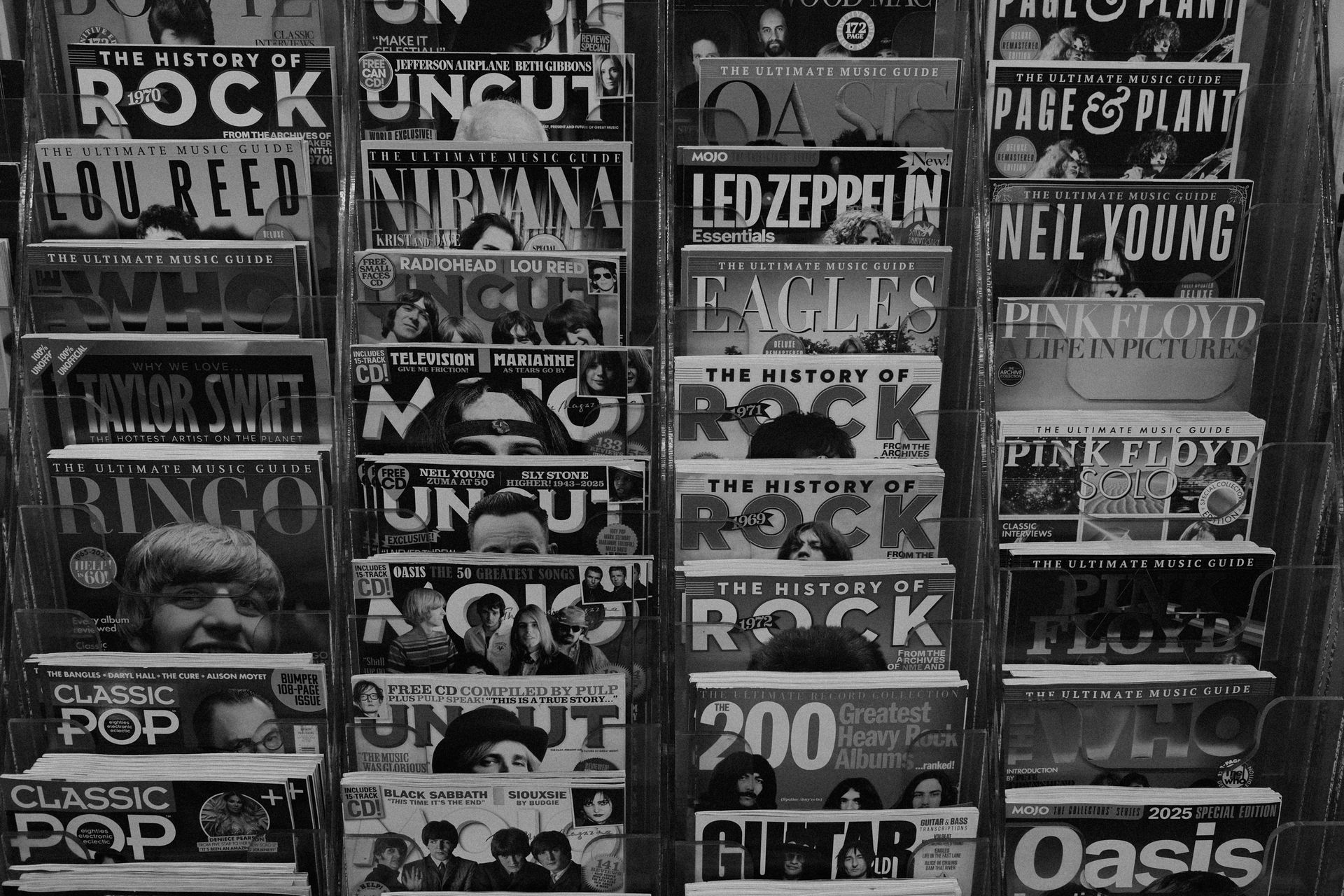

Hello You,
Last week we went digging through the vaults of dead artists... kinda. We had a couple of email replies, which we always enjoy, but the one that caught our ears was WAREHOUSE SUMMER by i_o, made with Lights. Lights has said the two of them made the album together in 2020, and it came out on the two-year anniversary of his death. That clears our CIRCLES bar.
This week we're talking dead of a different type. The death of the glossy pages.

1000 quid bible
NME almost didn’t happen. A London promoter called Maurice Kinn bought its predecessor, The Accordion Times and Musical Express, for £1,000, fifteen minutes before it was due to close. Looking at it now, we'd like to think we'd do the same. It seems such a small amount for an industry-changing bunch of paper.
It went on to sell 306,881 copies a week in 1964, at the height of Beatlemania. By the end of 2014, paid circulation (copies sold) was 15,384, down from about 70,000 ten years earlier.
NME became a freesheet in 2015, handed out at stations and universities. Its first free circulation figure averaged 307,217 copies a week, the highest in its history.
So people still picked it up, we still wanted it. They just stopped paying for it, like most things. We want it all for free.
The free version didn’t last either. NME scrapped print in 2018, citing rising production costs and a bleak advertising market.
Then in 2023, it came back. NME is in print again as a bimonthly, sold in a bundle with its sister mags.
queue cue Q
Q was founded by two Smash Hits writers. It was originally called Cue, as in cueing up the next record, and changed to Q so it wouldn’t be mistaken for a snooker magazine.
The last editor, Ted Kessler, blamed the pandemic. In his final letter he wrote, “I must apologise for my failure to keep Q afloat.”
He apologized for twenty years of decline he didn’t really cause. In our opinion, it was the state of the industry before, or at least where it was heading. Sales had already dropped from over 200,000 in 2001 to under 30,000 in 2019. The pandemic just sped up the ending.
Mind you, Q came back online in 2024, then closed again a few months later.
quick with it
The weeklies used to be how you found out first. The newest band or the split landed on your doormat before anyone else knew, or on the rack if you were like us and went to get it. Then the internet started doing that job for free, and faster. Fans were hearing new music weeks before a magazine could write about it, and by the time the monthlies went to print, half of it was old news.
They lost the keys to the door, too. Now your favorite obscure band is a YouTube search away. MySpace launched many musicians. Why read about the band when you can instantly hear them? Why buy a magazine when you have a chance of communicating with your new obsession in their comment section for free?
And then there were the CDs. The covermount (the free thing taped to the front) goes way back. NME was giving away flexi-discs in the 1970s, and its C86 cassette in 1986 still gets talked about. For a while it worked. A Sunday paper once sold an extra 600,000 copies off the back of one Prince album. Labels loved it too. It was cheap promo for new acts.
The catch is a freebie only lifts the issue it is stuck to. Once readers expect it, it becomes a permanent cost. The extras across the shelf kept getting bigger, too: DVDs, toys, bundles of whatever might shift one more copy. Then file sharing turned up, and a free CD wasn't special anymore, because everything was free... if you felt piratey enough.
A lot of the ad money came from record labels wanting to reach people who were already music fans, and once labels moved their marketing to social media and blogs, the pages got thinner. RAM in Australia had a loyal readership and still folded.

where the money goes...
Readers never really paid for magazines. The cover price covered a small part of it. Advertising paid the rest. And even the global mega stars on the cover appeared for free. When ad money moved online (because we all moved online), it didn’t come back in the same amounts. Being built for the internet didn’t save anyone either. Pitchfork was supposed to be the future, and in 2024 Condé Nast folded it into GQ, with layoffs. So it really wasn't so much about the readers, just the complete lack of funds. We'd been waiting for Condé Nast to do something since it bought Pitchfork in 2015.
The dead list keeps growing. Guitar Player printed its last issue in December 2024. Computer Music stopped after issue 340, and its staff moved to its sister website.
back issues
Kerrang! started as a one-off. The first issue came out on 6 June 1981 as a “Heavy Metal Special” from Sounds. It sold well enough to become a monthly, and went weekly in 1987. The name comes from the sound of a power chord played through distortion (some fun, useless information for you).
Then nu metal hit, and Kerrang! got huge. It overtook NME as the UK’s best-selling music weekly, and by mid-2002 it was selling 83,988 copies a week. The weekly print edition ended on 13 March 2020, after 1,818 issues.
And realistically, and maybe cynically, the people who shouldered a lot of the cost for the magazines to be great and in print were the less-than-10p-per-word writers. Just before Christmas 2025, Kerrang! told its freelancers payment would now take 60 days instead of 30. Sixteen contributors refused to write another word until management met their terms, and by January 2026 Kerrang! had backed down.
Sounds, the paper that started Kerrang!, is gone. So is Melody Maker. It began in 1926 as a jazz magazine, became one of the world's oldest music weeklies, and stopped in December 2000.
Smash Hits taught a generation the words to everything. At its peak in the first half of 1989 it sold 786,886 copies an issue. When it closed in 2006 it was down to 120,541. The publisher's reason: “teenagers now get their pop news and videos online.” Neil Tennant of the Pet Shop Boys worked there, and remembers looking smugly across the street at the NME staff, who seemed to be having much less fun.
Popworld Pulp was a flash in the pan, launched in 2007 and gone after two issues.
America went the same way. Spin stopped printing after its September/October 2012 issue. Subscribers were sent Car and Driver for every issue left on their subscription. Picture signing up for college rock and getting horsepower mags instead. Vibe went too, dropping print to go digital.
And one came back from the dead. Creem, founded in Detroit in 1969, shut down in 1989. In 2022, the founder’s son, JJ Kramer, brought it back print-first, even though US print publications lost about 40% of their revenue between 2002 and 2020. It's mostly sold by subscription.
Look at what survived: Kerrang! printing four times a year, Creem quarterly, NME back every two months. The weekly might be dead, but there are still pages to be flipped, every once in a while.
Question: do you still buy music magazines? Send us an email and let us know.
A playlist? Always.
See you next Thursday
P.S. We've been busy behind the scenes. Our new community page is up, with a Crate where you can add what you've been listening to and rate it.
Artists and bands, submissions have a new home too, and they're still free. Be mindful we get over 200 a week right now, so we're getting through them slowly.
Our writers pool is opening up. If you've got something to say about music, send us the idea - read the guide first.
And there are a few other new bits around the site, so go have a poke around.




Log in or subscribe to comment