

Brought to you by Music24
Hello You.
Last week, we took a rose-colored look at how the early 90s changed and shaped the music industry. This week, we’re looking at a piece of tech that was shunned until it became a must-have and hard to find.
Gif by Animationseries2000 on Giphy
Transistor Rhythm
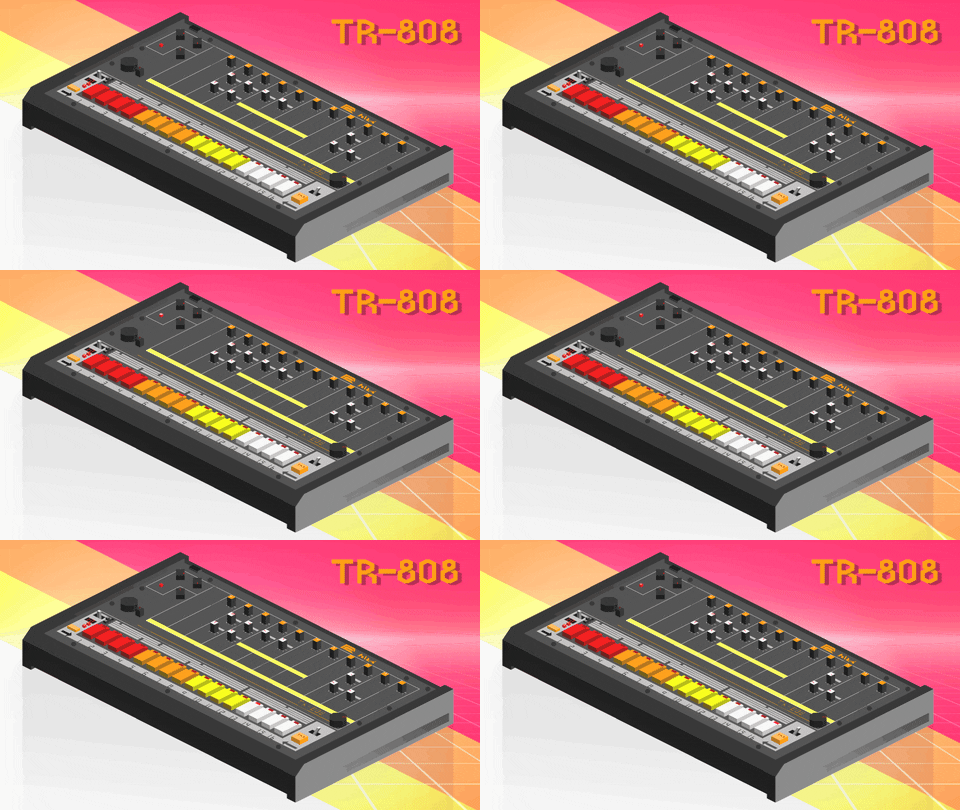
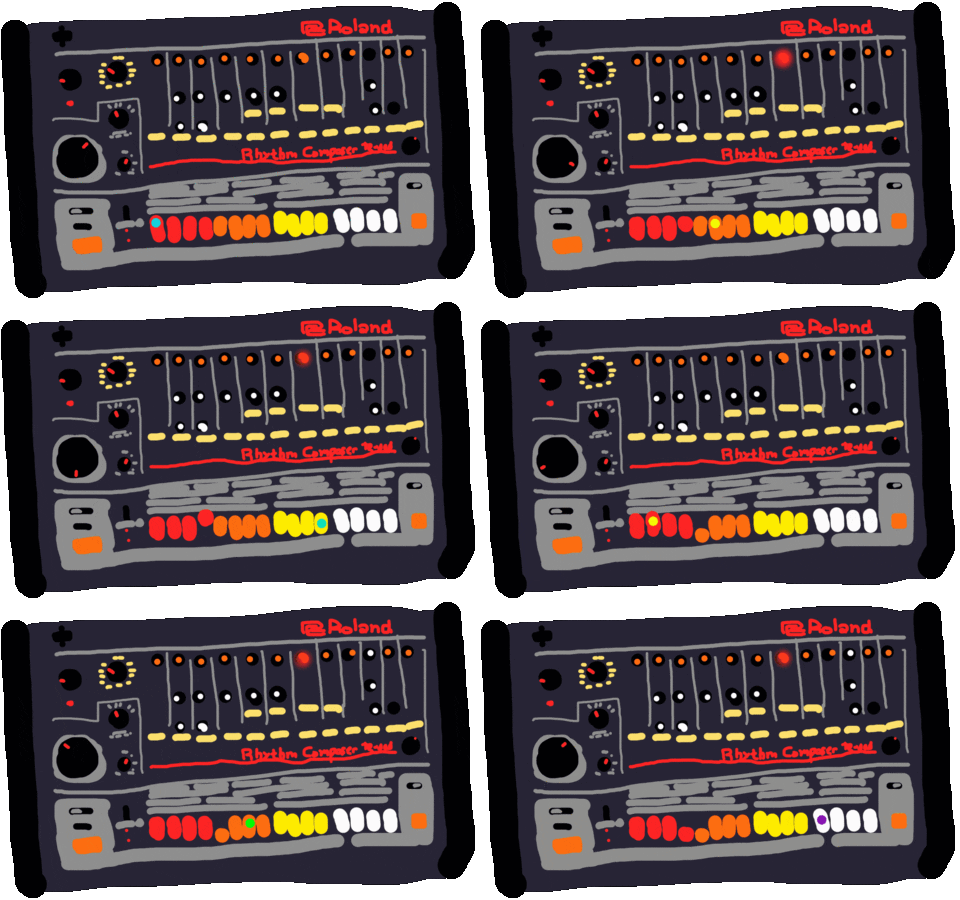
Roland put the TR-808 out in 1980. TR stood for Transistor Rhythm, which tells you how much they were leaning on the transistor.
Here's the bit we love. Ikutaro Kakehashi, the man who founded Roland, went out and deliberately bought faulty transistors. Not cheap ones. Rejected ones. Components that had failed quality control and been set aside, because the way they misbehaved made exactly the sizzle (yes, the sound) he wanted. Roland even painted the tops of them so the factory could tell which ones were the good-bad ones. One man’s trash is another man’s treasure.
It flopped. Properly face down in the dirt flopped. It cost $1,195 while the Linn LM-1 came out the same year, using actual sampled drums for $4,995, and everybody with money bought the Linn; in fact, anyone who was anyone wanted it. The 808 didn't sound like drums. The kick was too deep, the snare was thin, and the cowbell sounded like nothing on earth.
Around 12,000 were built, and not all of them even sold.
Then, in 1983, Roland killed it, and the reason is kinda cool. Transistor manufacturing got better. Quality control improved, the number of defective parts dropped to almost nothing, and there simply weren't enough broken transistors left in the world to keep making it.
The machine died because we got too good at making things properly. And the bad parts weren’t bad enough anymore. (Or another theory is that they had just used cheap, badly made parts in the first place, they stopped making the part, and then they couldn’t make any more.)
Second-hand units hit pawn shops at around a hundred dollars - and you know who managed to get their hands on it? People who could make this Frankenstein’s monster of a machine do something good.
Which is how they ended up in bedrooms in Detroit, Chicago, and New York. It gave a sound that wasn’t everywhere. (The button below is better on desktop.)
When is a drum not a drum?
Trap lovers will already know, most likely.
An 808 is a sine wave with a long decaying tail. That's it. There's no drum in there, but people have become exceptional at making these broken toys sound like one.
A sine wave is the simplest sound there is. One frequency, nothing stacked on top, no texture, no grit. It’s what you get out of a tuning fork.
Which matters, because every other note you have ever heard is a fundamental with a stack of harmonics sitting above it, and those harmonics are what your brain uses to work out what it is listening to. A sine has none of them. It is all bottom and nothing else.
It has a pitch. It sits in a key. You tune it like you'd tune a bass, and if you get that wrong, the whole thing sounds like smashed together rubbish real quick.
Knock, knock
We associate anything with a thump or something rumbly with drums, but in the case of this Roland, that thump isn’t a separate drum layer. It’s what we call a pitch envelope.
An envelope is a shape over time. Change this thing, by this much, over this long, then stop. That is all it is.
Usually it is pointed at volume, which is why a note swells and fades instead of just appearing and vanishing. Point it at pitch instead, and the note moves.
Point an envelope at the oscillator's pitch, set it to +24 semitones with no attack and a decay of about 60ms, and every note now begins two octaves too high and falls into place as fast as you can blink.
You have never heard that high note as a note. It's too fast. Your brain reads it as a knock and files it under percussion.
And you can hear people playing with it. Push it to +36, and the attack gets clickier. Stretch the decay to 120ms, and the knock turns into a lazy boom, which is lovely at 130 to 140 BPM and turns to sound soup at anything quicker.
Giphy
Purposely filthy
The distortion isn’t an accident… well, sometimes it is. But in this case, every bit of distortion you add throws off overtones, extra frequencies stacked above the note.
A clean sine at 40Hz does not exist on your phone. The speaker physically cannot make it. Dirty it up on purpose, and the harmonics land where your speaker can reach, and your brain does the rest and hands you back a note to process.
We've been here before.
So the filthy isn't there to sound hard. It's there so the bass exists at all on the thing you're actually listening on. Kakehashi bought broken transistors. Producers break the sine on purpose. Same idea, forty-odd years apart.
Namesake
The 808 became a calling card. Because while in some areas of the music industry it was a failed experiment, in others, the places where music changes, it was the thing to use and master. 808 Mafia was formed in Atlanta around 2010/11 (sources are split on the date), Waka Flocka Flame's idea, built out of Lex Luger and Southside. They named themselves after the drum machine. Then MP808 joined, who had already named himself after it, too.
A production collective named itself after a discontinued piece of Japanese hardware that failed so badly it ended up in pawn shops. That's the machine's second life in one sentence.
Southside, Joshua Luellen, goes by 808MafiaBoss and produced nine of the ten tracks on Future's 56 Nights mixtape. He made the whole thing in one night.
Lex Luger co-founded the group and left a year later, having won Producer of the Year at the 2011 BET Hip Hop Awards on the way out.
TM88, Bryan Simmons, came out of Miami into Atlanta and went on to Migos, Drake, 2 Chainz.
And further back, Shawty Redd, Demetrius Stewart, who's widely credited with building the fast hi-hat pattern that became trap's fingerprint around 2000.
The lineage runs Shawty Redd, DJ Toomp, Zaytoven, Lex Luger, and Metro Boomin. In trap the beat is half the song, so the producer sits closer to co-author than session hand. Which is why they get named on the track and why they name themselves after the box.
Not everything that sounds like a TR-808 is an 808 anymore. It has come to mean more than just the machine of busted parts.
Around 12,000 were ever built, and they've been out of production since 1983, so the hardware is genuinely rare and priced accordingly. The people who want the real circuits pay real money for them, and the pawn shop era is long gone.
Everyone is trying to make something close.
One oscillator, set to a sine wave. The pitch envelope for the knock. Then a short click layer on top, high-passed so it doesn't muddy the bottom, and sitting well under the sine, doing the attack while the sub does the actual work. Two layers pretending to be one sound. That's it. That's an 808.
Building it rather than sampling it has an advantage, too. You can tune it to the track, glide between notes, and shape the knock to fit. Full control.
Roland eventually rebuilt the original circuits in software, and while they were at it, they added the ability to tune the bass drum properly. Which is kinda funny, because tuning is the thing modern producers care about most, and it's the thing the original made hardest.
And then there are the sample packs. Every producer has a folder named after somebody else. Metro Boomin's kit, Lex Luger's kit. Samples of samples of samples of a machine that many of the people using them have never touched.
Which is where it ends up.
The 808 stopped being just a box and became a noun.
Kakehashi went out and bought broken transistors to get a sound nobody even wanted. Forty-five years later, people build a clean oscillator and then break it on purpose just to try and get there.
The machine got discontinued. The sound? Bigger than ever.
A playlist? Of course.
For fun, Sleng Teng is using a Casio MT-40, while Blue Monday is using an Oberheim. Take a listen to the tracks and hear the different machines in action.
See you next Thursday.
New mix
mustbejohn, nochvnce & More - SongsBrew RADAR MIX22



Log in or subscribe to comment