

Brought to you by Music24
Hello You.
Last week was a whirlwind of busyness at the Reeperbahn Festival. We’ve added some of our favorite artists at the bottom of this newsletter. This week, what does sad music do to us? Does it help or hinder when we’re feeling at our lowest? Fair warning, this one is a little deeper than some of our regular newsletters. If it’s not for you, we’ll see you next week.
The blues
Everyone has a song or maybe an album. The one that comes on when things are bad, and somehow, it makes things a little less bad. Not fixed. Just... less heavy. Which makes no sense when you think about it. You're sad, so you put on something sadder. Like treating a burn with a hot pan.
And yet. We all do it (well, maybe it is just us…)

Giphy
The internet likes to talk about a theory.
It's called the prolactin theory, and you've probably read it somewhere - a listicle, or a friend who read the listicle and loves to pepper you with new information. The idea came from musicologist David Huron. Sad music tricks your body into bracing for grief; it releases prolactin (a hormone that helps soothe loss), and since nothing bad actually happened, you're left holding the comforting part without the loss. A free hug from your own brain, which sounds kinda nice.
A lovely idea. Also wrong. And we know that because the guy who came up with it said so. Huron's own lab measured listeners' prolactin and found nothing. No change, no link to how much anyone enjoyed the music. A team in Finland tested it again and found no sign of the grief response either. So Huron did something almost nobody in academia does and published a paper called The Prolactin Theory of Sad-Music Enjoyment is Wrong. That's the actual title. We respect it enormously.
Which leaves the question wide open again.
Bitesize
Researchers split emotion in music into two things. Perceived emotion is what the song is expressing. Felt emotion is what actually happens in you. Most of the time we mash them together into feeling soup, but they aren't the same, and the gap between them is where all the good stuff lives.
A sad song is sad. You know it's sad. You recognize every bit of the grief/loss/tortured soul in it... you just don't have to suffer for it. Nobody left. Nobody died (apart from the times they did, but we’re not talking about that yet). It's melancholy in a portion you can handle, three and a half minutes, and then it ends. Bitesize. Researchers in Japan found that listeners with musical experience rated minor-key music as more pleasant when describing what they felt than when describing what they heard. Sad on paper. Something else in the chest.
That something else has a name. Being moved. Yep, really. In a study of 308 people, the link between feeling sad and liking the music vanished completely once being moved was taken into account. The sadness wasn't what was doing it. The moved feeling was. That weird, heavy swell behind the ribs, the lump that isn't quite crying? That's the payoff. The sadness is just the means of delivery.
And not everyone gets the delivery. When the Finnish team played sad instrumental music to 62 women, only the high-empathy listeners reported a lift in mood and felt properly moved, and their hormones shifted in a way that looks like reward, not grief. Everyone else mostly just... listened. So if you've ever been completely wrecked by a song your friend called boring, it might not be taste. It might be wiring. (Hello again, Musical Anhedonia.)
Stack sad on sad
Okay. That's sad music on a regular Tuesday. What about when you're the sad one?

Gif by theoffice on Giphy
This is where it gets interesting. A team at the University of South Florida found that people with depression were more likely to pick the sad tracks (okay, this might not be a shock), Barber's Adagio for Strings among them, and when asked why, most said roughly the same thing. It calms them down. Not cheers them up, calms.
And they genuinely felt better after listening than before.
A follow-up that tracked people through their actual days found the same trade for pretty much everyone, depressed or not: more relaxed after a sad song, a bit less happy. Which is honest, at least. Sad music was never a pick-me-up. That’s not what it is made for.
If you've ever put on something upbeat on a bad day and wanted to launch your phone across the room, you already get it, and you’re not alone - we get it too. Happy music on a bad day is someone clapping in your face at a funeral.
When it's real
And then there are the times it isn't a mood. Someone did leave. Someone did die. Some awful stuff happened. This is where sad music does its oddest, kindest work.
Researchers at De Montfort University looked at around 450 people and what they listen to when things go wrong. Most preferred happy music day to day. But when the bad stuff got overwhelming, they went sad, and they went looking for consolation. The researchers call it acceptance-based coping. Loss, as lead researcher Annemieke van den Tol put it, is "not a problem which can be solved or reversed," so the only real way through is to sit with it. Happy music tries to fix it in a way that we don’t want or we aren’t ready for. Sad music just kinda sits with you as you go through it.
Eric Clapton wrote Tears in Heaven after losing his four-year-old son, and has talked about it as part of how he healed. It's in the Moving Sadness playlist, if you need it. Sometimes the song is just there so you're not doing it alone.
Three kinds of blue
Here's the bit that'll change how you listen, maybe. "Sad music" isn't one feeling. Eerola and Vuoskoski found it splits three ways.
Relaxing sadness - peaceful, soft, weirdly pleasant. The warm bath type of feeling.
Moving sadness - intense, lump-in-the-throat, the being moved from earlier. The good cry, probably the one you needed.
Nervous sadness - anxious, uneasy, a little scary. The one that makes it worse.
All called sad. Three completely different jobs. Most of us have moved through all three without knowing there was a difference, but you can feel it. Which is why sometimes it helps, and sometimes it really, really doesn't.
The catch
So is it healthy? Mostly, for most people, yes. But there's a catch, and it's a big one.
Rumination is replaying the same bad thought on a loop. Same thought, same angle, over and over, going nowhere. Sandra Garrido and Emery Schubert found people who ruminate are drawn to sad music even when they don't enjoy it, and even when it doesn't help. The part that we paused on for a while: in one of their studies, heavy ruminators said the sad music helped them... while their general depression scores went up.
We are not always the best judges of what's helping us.
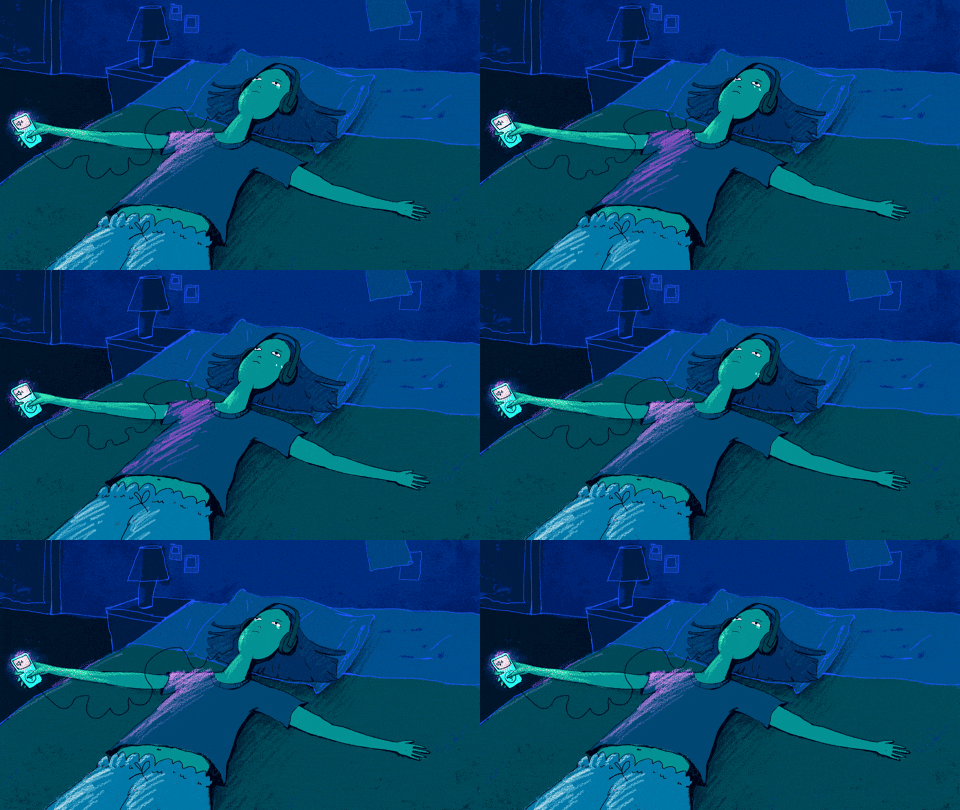
That's the line between listening to a song and using a song as background noise for the same thought on repeat. One is processing. The other is rumination with a soundtrack. And it's easy to slip into - same song on repeat, headphones in, door shut. Music stops being company and starts becoming something else.
Gif by AlaynaJoy on Giphy
Check yourself
Next time you reach for the sad stuff, give it three songs, then ask:
Calmer or heavier?
Thinking about the song, or thinking the same thought about your life, again?
Would you play this tomorrow for the music, or only for the mood?
Calmer, song-first, music-first? Carry on, you're doing it right. Heavier, looping, mood-only? Swap the nervous track for a relaxing one, or turn it off and go stand outside for ten minutes. Not a ban on sad songs. Just a check-in.
And if the heavy feeling hangs around for weeks rather than a few songs, a playlist isn't the right tool, as good as music is. Talk to someone - a friend, your doctor, anyone.
For us, for a while, it's Call Your Mom by Noah Kahan - we either have that friend or person, or have been that friend or person. And if you haven’t ever known, or been either of those, then it’s worth a listen anyway.
This week, we’ve split the playlist up.
See you next Thursday.
As promised, here are a few recs from Reeperbahn Festival. JOSY, experimental, very cool. Maia and the Squires live are excellent. WRKHOUSE was tucked on a very tiny stage - they really needed something bigger.



Log in or subscribe to comment