
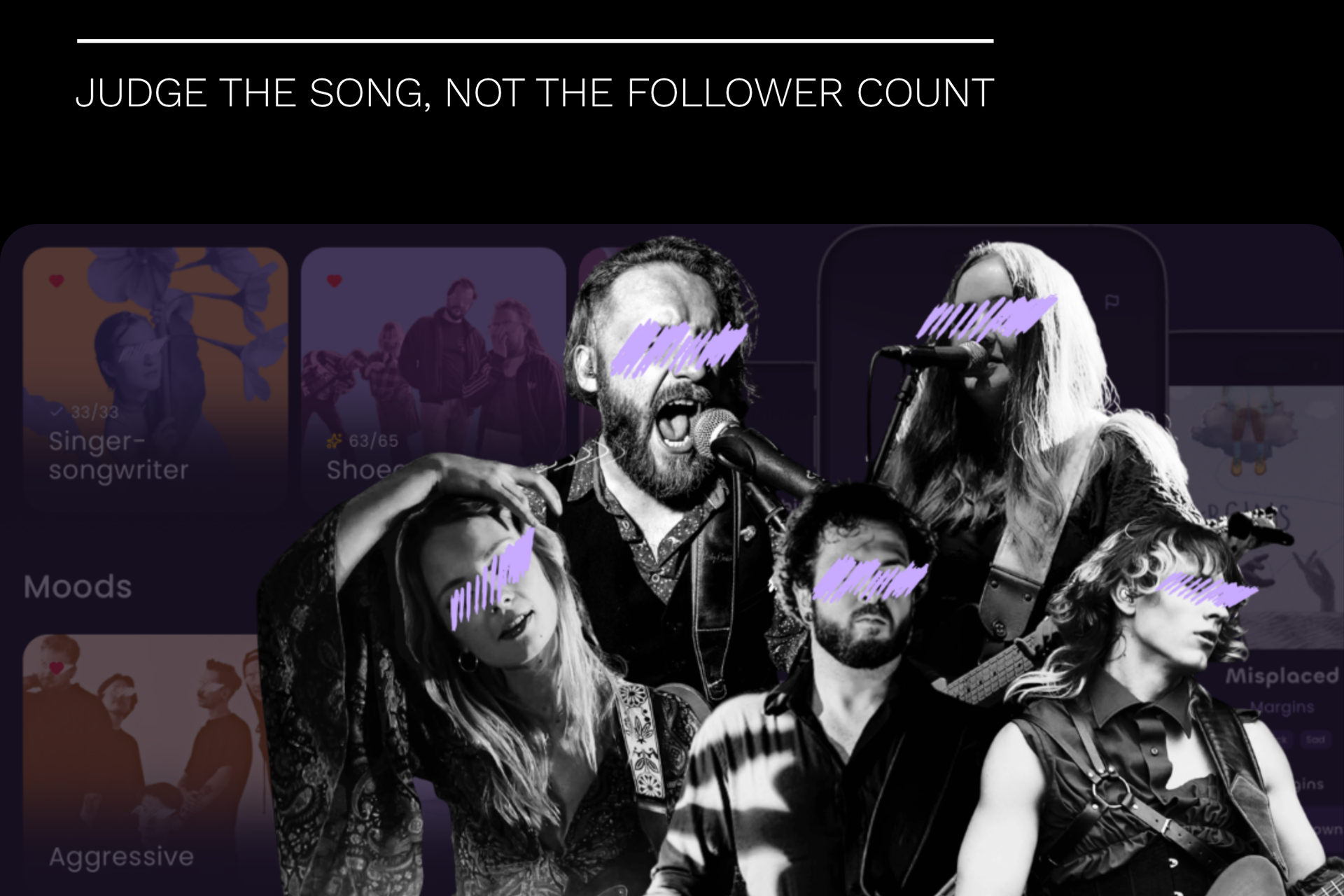

106,000 new tracks a day. That is roughly how many landed on streaming services on average in 2025, according to Luminate. And yet, despite that avalanche, we keep listening to the same dozen or so names. Unknown Band was created to change that. Behind the project stands a group of independent musicians, including CEO Bartek Mieżyński, who performs solo and plays in the bands Bujaturla and Dla Kontrastu. They describe what they do as a response to years of frustration with the music industry, with the realities of promotion, and with the whole social media world that surrounds music today.
One sentence from their site stuck with us the most: "Nobody wanted to help the underground, so the underground took matters into its own hands." That is not just a nice slogan; it is a literal description of how and why this app came to be.
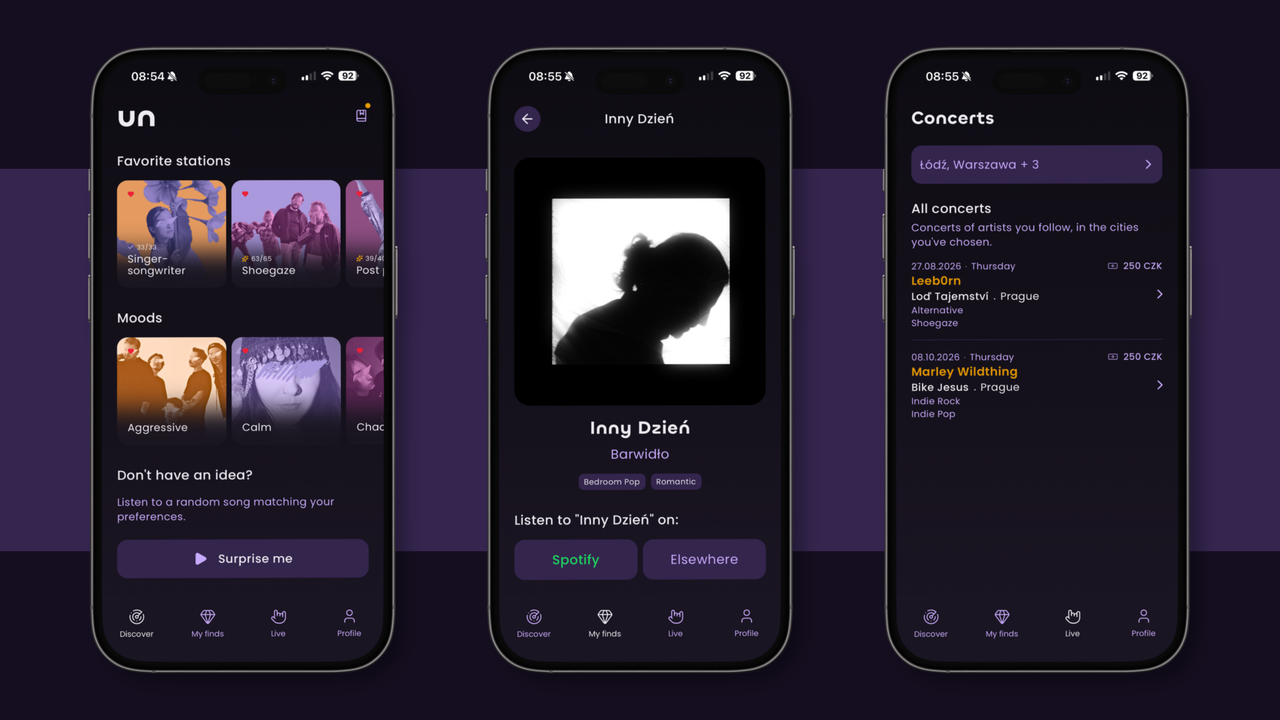
The rules are simple. You pick a genre and the mood you happen to be in, or you leave it up to chance and hit "Surprise me". You listen to a track with no name, no cover art, nothing that could prejudice you one way or another. Only if you like it do you find out who you are actually dealing with, where to look for them next, and whether they might just be playing in your city - because the app also has a separate tab for gigs.
Artists gain the most from this. Nobody asks about connections or follower counts, and every submitted track is checked by hand so it does not get lost in a crowd of AI-made knock-offs. The rating comes purely from the sound. That same principle of locality also works in their favour - their music reaches people from the area first, meaning the ones who can realistically show up to a gig.
We had the chance to talk with Olga Stolarek (Community Lead) about where this frustration comes from, what the fight against AI music looks like from the inside, and what an app like Unknown Band actually changes for independent artists. Olga is responsible for social media and community, but she knows music from the other side of the stage too. For nine years she has sung in and co-created the band Heima, with whom she has played several hundred concerts and released three albums. She also runs the PR and booking agency Smutki.co, where she helps independent artists earn media attention.
Maja Marczak: From your experience, as both an artist and someone who works in marketing, what frustrated you most about the way the industry works today?
Olga Stolarek: What frustrates me most is something I unfortunately often do myself, because I understand where it comes from. First, that nobody in this industry replies to messages and that it is hard to get anything sorted, though I do understand it a little, because when I have a lot on my plate, replying to emails that do not interest me is the last thing I think about. Obviously it would be nice to get an answer along the lines of "sorry, but this isn't going to happen", but that is probably still last on most people's list of priorities. It is also frustrating that mainstream music is promoted everywhere. It is a bit like being a young person looking for a job, where the employer expects five years of professional experience right away. It is similar in the music industry. You often hear: "we'll promote you, but once you're already someone big." Only how are you supposed to become "someone big" if nobody wants to help you because you are a beginner and unknown? Of course there are various programmes for newcomers, but they are often rigged and aimed at people who are already signed to labels. Genuinely independent artists, who want to go entirely their own way and do everything themselves, regardless of whether they are very good or not, have little chance at it. And now there is AI music on top of that. I get the impression that streaming platforms only pretend to fight it. Beginning artists have to break through not only the big artists, but AI music as well. For a lot of people it makes no difference whether the music was made by a human or not, which for the people who create this art is absurd and incomprehensible. There are plenty of these frustrations, and I could probably keep finding more of them with every passing minute.
MM: On the AI point, we ran our own little experiment at SongsBrew. We built an AI artist to see whether the streaming services would catch it, and so far our AI track is still up on both Deezer and Spotify. Nobody's taken it down. But you mentioned the newcomer programmes. Did you ever try to get onto one of the talent shows here in Poland?
OS: I was referring more to the support programmes set up by the streaming platforms themselves, but I cannot name specific ones. There are support programmes for newcomers in which those "newcomers" always turn out to be people who already have contacts and an in with the industry, rather than the ones actually doing everything on their own. As for television programmes, there was one time when a scout called us himself and suggested we should apply. But even though they were the ones who called us, we did not get through to the auditions. There is one more programme whose format appeals to us more. A lot of our friends have applied there too. In practically every episode we literally see someone we know. Seeing that they benefit from it, I absolutely do not rule out that we will give it a try one day as well.
MM: The app grew out of a group of musician friends who decided something had to change. Did someone just float the idea one day and it stuck? This all kicked off in September 2025, right?
OS: The company was founded in September 2025, and we started working on it in a larger group, and the app itself launched in February. The idea belongs to Bartek. He was the one who, out of that frustration of being a musician and exactly what we were talking about, independent artists being unnoticed and nobody helping them, came up with Unknown Band. It also stemmed from the fact that the streaming playlists with names like "Discover Weekly" or "Hidden gems for you" do not live up to their premise. Those playlists were full of very well-known artists. Bartek saw that these playlists do not work the way they should, because the name itself says these are unknown artists, and then you go in and see artists you know well and listen to, with a million monthly listeners. He saw that it clearly does not work and that something had to be done about it. Besides being a musician he is also a programmer, so he built a prototype of the app for a competition, and it worked out. He won an award and was in the Top 3 of the EMEA region. Once he was sure it made sense, he started working on it seriously.
MM: Where did this way of listening come from, with no title, no artist name, no cover? It could just as easily have been a straightforward playlist of underground music.
OS: I think it also came from the frustration that artists have to be influencers at the same time and are expected to create content. The music itself is often only 5% of what actually gets done. I myself did not believe the line that music can speak for itself. I really wanted to, but I knew it was hard, because in reality everything around it gets judged. We wanted that to be the case with us, and for there to be no distractions. Sometimes it is a matter of looking at someone or seeing a song title and immediately becoming prejudiced. Or we have already heard a track by a given artist once, so we assume in advance that another one will not appeal to us either. We see that someone has only 100 listeners, and we think that with such a small number the artist is not worth our attention. We wanted to avoid such prejudices, which are completely unnecessary. Obviously someone has to start with 100 listeners in order to later have 100,000. Bartek often gives the example of comments. When people see even a single negative comment, they judge everything on the basis of that one negative opinion, because "if someone says it's bad, then it surely is." We want everyone to have a clean slate, not to be swayed by other people's ratings, and for nothing unrelated to the track itself to make them skip it. As far as we know, there is no app quite like this anywhere, neither in Poland nor abroad.
MM: We use Groover at SongsBrew, but that's a completely different thing. There you get the whole bio, all the socials, everything. I had to train myself to ignore the cover and just listen. Now an artist with 50 monthly listeners excites me more than one with 50,000. I think everyone could stand to flip that instinct and back the people making music out of pure passion.
OS: My band has not experienced it, but I know from friends that it is getting harder and harder to book a gig. Organisers can straight up tell you that you have too few followers on Instagram. Even when they like your music, they look at it through the lens of online reach. Our platform exists to prevent situations like that and to get people to focus on the music itself and give it a chance.
MM: Everything now comes down to being an influencer. Content has to be fast, you need a hook, you're fighting for the first two seconds, and we know how hard attention is to hold. Music got dragged into that too, TikTok especially: tracks built to be short and catchy. Unknown Band gives you 20% of a track and nothing else, just the sound. Did you test that number to land on where a listener should decide?
OS: Ever since I have worked at Unknown Band it has always been 20%. We are aware that people would not last if it were the whole track. Some tracks are also very long. We have one, for example, that runs 40 minutes, so respect to the people who listen through that 20% anyway. We got feedback from one artist that the threshold should be higher, whereas the listeners wanted it lowered, so opinions on this vary. We wanted to find the golden mean. It is worth mentioning that the 20% only means you can rate a given track. It does not mean you have to stop listening to it. You can also pause the rating screen and hold off on rating until the end of the track. We also thought about letting the artist decide which fragment the track starts from. On the other hand, we also want to teach mindfulness towards music, not to "TikTok-ify" it, and to let those long intros ring out. We do not want to break our own rules and cut songs down to two minutes just so someone can hold their attention. Our goal is to provide artists with listeners who are able to hold out and focus on the music itself. We are aware that this is not an app for everyone, and we say so clearly, because we have a clear goal. Our target user is someone who actually wants to discover music, not just listen to it in the background.
MM: Did anything about how people actually use the app surprise you, or overturn an assumption you started with?
OS: We recently noticed that regardless of how many tracks there are in the database and how many users there are at a given moment, there is always practically the same percentage of rated tracks. Whether there are 700 tracks and 20 people listened to them, or 700 people and 20 tracks, in any configuration the daily statistics show the same percentage of tracks that got rated or reviewed. Users behave very similarly and review a similar number of tracks. They often only leave a rating instead of writing a text opinion, and those are the ones we care about most. It is optional and we absolutely do not force anyone to do it. Still, it is always nice to see how happy artists are to see a review like that and to share it on their social media. Artists also have access to anonymous comments from users. It would be great if people understood that it is worth writing someone a few words, because artists really appreciate it.
MM: I know that feeling well. People are reluctant to leave a written opinion. A click is easy; getting someone to actually write something is the hard part. Was there a specific moment when you thought: this really works?
OS: There is one thing that surprised us, more from the artists' side than the listeners'. Artists themselves started using our platform to do pre-releases of their tracks. They figured it would reach a small group of listeners, no one would know exactly what it is, and they could count on honest feedback. We moderate all tracks by hand, and we started noticing that a track had been added but the release date was only set for the following week. With pre-releases there are also no streaming links provided, so we immediately see that yet another artist wants to first test a track on a smaller audience before releasing it. Artists also run A/B tests to see what to release as a single. After uploading two tracks, they check which one was received better and release that one as the single. It really surprised us, because the artists came up with it themselves, and we are glad they are so active. That was one of those moments when we made sure that what we are working on makes sense. Artists also started using the app to discover other artists. In a sense, developing features like that is our goal for the future. We want to make it easier for them to connect with one another. We follow a local-first principle, meaning you discover artists from your own city first. Thanks to that, musicians from the same city started getting in touch with each other, and there have already been a few cases of bands arranging a joint concert. I recently ran an interview with the top performers of the past month and asked them precisely about discoveries in the app. They replied that they use it to find other artists for joint performances. An artist's profile now also shows their upcoming tour dates, so the moment you like someone's work, you see a list of their next gigs. Another moment when we feel that it really works is the feedback from listeners. When we ran a competition, one girl wrote in her entry that while discovering music she found a certain band and dreamed of going to their concert. On Unknown she saw that they were playing in her city in 3 days, and she sent us a photo of her phone with that comment, taken against the backdrop of their concert. We also see a lot of comments on YouTube: "came here from Unknown and I'm staying for good."
MM: I was going to ask about building a community, but it sounds like yours is building itself. You landed on a niche that was missing exactly this.
OS: At the start we saw huge interest from the media. People treated it more as a passing curiosity. Now we are at the stage of introducing new features that will encourage people to use the app more often and stay for longer. As for artists, we practically never had to take any major action to encourage them to try Unknown Band. They became interested on their own, and to this day their community builds itself spontaneously. That made things much easier for us and changed our plan a little. We thought it would be the artists who would be hard to acquire. Right now we want to expand into the foreign markets and pass our idea on further. We also managed to run a few smaller events for our community. During a festival where a lot of our artists played, we had the chance to sit down together and talk about what people would like to add to the app, what they like and what they do not. We take every piece of feedback into account. At the creators' request we introduced a light subscription so that every beginner has a chance to share their work. Overall we see that people are very engaged and want to build this community together with us. They have noticed that there is someone who genuinely wants to take care of this independent scene. That is the best part of it all for me.
MM: That's great to hear. A community you actually talk and trade ideas with is one of the most valuable things a creator can have, and both sides pull each other up. Talking to beginner artists privately, I've noticed they're often embarrassed to share their music, afraid of being judged. On Unknown Band you can't see who the artist is, so there's anonymity, up to a point. Even so, has anyone still hesitated to upload out of that fear? Is it easier for them without a face and a name attached?
OS: I myself do not like it when someone listens to my music while I am there, so I understand artists who feel the same. We have a few artists who added their music to us but never released it anywhere. It is possible that this is some kind of signal that it is easier for them. I am in touch with a lot of artists, but we have never brought this topic up. All the same, I would say it is easier for them. Artists often send us unfinished or unpublished tracks, because maybe it is a kind of safe space for them. With us there is no requirement for the file to be a studio version; you can send a demo or a live version. The way a track was recorded does not matter, provided its quality allows for comfortable listening. We simply want people to dare to share their music.
MM: Back to AI music for a second. You've got a lot of artists and a lot of submissions. How do you actually verify a track wasn't made by AI?
OS: For us it works like this: there are registered artists and ones who have active tracks, meaning they currently have a subscription. There are around 1,000 registered artists, and at the moment 250 of them have active tracks. We are aware that we are not like a streaming service, where music is available all the time. With us, artists add music at the moment they want to promote it a bit, for example during the month of a release. Artists can deactivate and activate their account whenever they want. Out of the 250 active people, each has a maximum of 3 tracks that they can rotate. Whether a song is real or generated we check ourselves, every track one by one. When we are not sure, we check the artist's profiles on streaming services, on social media, or we reach out to those people directly.
MM: What does an artist really get from putting their music on Unknown Band that the streaming services won't give them?
OS: What matters is that they gain listeners who are looking for music and want to look for it. Listeners choose tags and specific genres, so you reach your target audience directly. We call it "caloric reach", because the genre settings are very precisely defined, so it reaches people who were genuinely looking for it. When you set up an ad on Facebook, the targeting options are now very broad, like "fans of alternative music". That does nothing for us at all, because alternative music could be any genre. With us it is more precise, so you reach listeners who are interested in your genre. On top of that there is a redirect to all social media and streaming platforms. In their dashboard the artist has access not only to ratings but also to statistics and demographic data, so they can check which city most of their fans come from. As I mentioned earlier, there is also a list of gigs, and the thing artists liked most is the venue database, a list of all the places where they can organise their concert. Besides the address they have access to all the information that makes it easier for them to get in touch. We keep all the data updated on an ongoing basis so it is as current as possible. Artists can sort the list by genre and see that, for example, a metal band has already played in a given club, so metal is welcome there. We try to introduce things that will be as helpful as possible for artists. Artists are additionally promoted in the cities where they are playing a gig. We follow a local-first principle, but when an artist from Łódź has a concert in Warsaw, then for 30 days before that concert they will be shown first to listeners from Warsaw.
MM: What would you say to someone who insists it all comes down to the algorithm and promo money anyway? Can you actually build something today that genuinely helps independent artists?
OS: I will not convince anyone that it is not so, because unfortunately it is a little bit true. We are aware of how the industry works, but we are trying to fix this situation and create an alternative. "Fixing the world" sounds very grandiose, but at least part of that world could be set aside for independent artists. It is worth fighting for that and looking for solutions like our app. Showing that it can be done differently and that listeners want this change too. Radio stations are often paid to recommend music that is becoming more and more "TikTok-y". Everything is short, catchy and starts to sound alike. We also need to educate listeners that it might be worth looking for music somewhere else.
MM: What is Unknown Band meant to be in two or three years: a real alternative to streaming, or a place that sits alongside it, for a particular kind of listening?
OS: Bartek always puts it nicely: "we're not flipping the table over, we're just pulling up a new one." We want to give an alternative to those who like searching for music and for whom what radio or streaming offers is not enough. What matters to us is being talked about as something that actually brought change and helped artists.
MM: Anything you'd say to nudge SongsBrew readers into downloading the app and trying it out?
OS: Behind everything we do are musicians working with other musicians in mind, not a corporation. We want artists to feel that this place was created for them and that they can count on our support. And if you are not an artist but simply like discovering music your friends do not know yet, you will find something for yourself here too.
Initiatives like Unknown Band do not happen often in this industry. Olga talks about all of it with real passion, not out of obligation. You can tell straight away that there is something more behind it than just an app. Unknown Band is a community and real support for the independent scene, which is exactly what we love to see. We appreciate what they do, and that is why we encourage you to check out Unknown Band.
Log in or subscribe to comment