

Brought to you by Music24
Hello You,
Last week we got expansive, talking about the width of sound, and more specifically how 40 milliseconds makes a difference.
This week we are listening to machines. Train tracks, washing machines, extractor fans, tumble dryers, the lot.
None of them are playing music or a beat (unless you have a washing machine that plays a tune when it is finished…). But you’ll hear one anyway.
Some of you will hear singing. We will get to that.

Gif by ReadyGO on Giphy
SongsBrew Editorial
Hearing things… or something else?
We know that the washing machine, the fan, and the train tracks aren’t making music or singing to us.
But for many people, listen long enough, and your brain will turn it into music.
Yes, yet again, our brains are doing fantastical things.
Part one: invented beats… and rats.
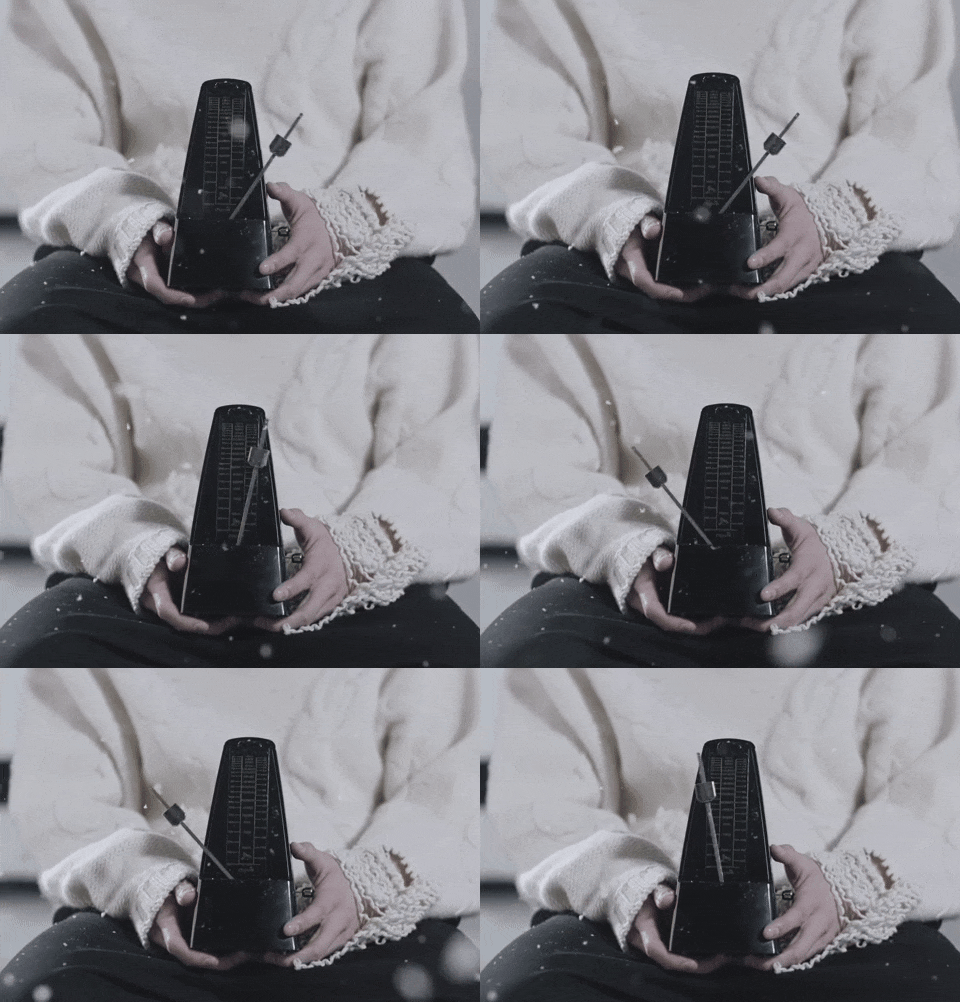
You’ve most likely seen and heard a metronome; they keep the time no matter what, but more importantly, you’ve heard TICK-tock, not tick-tick as it moves. But you’ve probably never really noticed.
Both sounds are actually identical, and the spacing is perfect. A beautiful tool. And we’re hearing it wrong.
Subjective rhythmization, or subjective accenting.
Thaddeus Lincoln Bolton, an American psychologist, published a paper called Rhythm in 1894. He was a PhD student at the time, and he spent his doctorate making people listen to evenly spaced clicks and writing down what they said about them.
The interesting thing, keeping in mind every click is identical, is that everybody heard an accent. The theory has been checked since and still holds up.
Another study, which has a much longer name, The Ticktock of Our Internal Clock: Direct Brain Evidence of Subjective Accents in Isochronous Sequences, used an EEG on people while they listened to a flat isochronous tone. Any tone the participant felt was louder showed a bigger brain response.
Our made-up louder accent on a tone physically shows up in the brain that made it up.
If you’re wondering about the rats… rats detect isochrony, and they don’t extract meter. In other words, they don’t hear a beat, only the clicks. So humans are making it up, and other animals, like rats, aren’t, and we’re not all that sure why we do it.

Gif by RespectiveCollective on Giphy
Part two: getting vocal.
Accented beats are only part of a bigger picture… or sound, in this case. The one where you hear singing in the extractor fan has a name too. Auditory pareidolia, which sits under the broader apophenia, our habit of finding patterns in things that don’t have any.
Apophenia comes from apo, away from, and phaenein, to show.
Pareidolia is para, wrong, and eidolon, image. Wrong image. It turns up in fans, running water, aircraft engines, washing machine hum, and white noise machines, which is to say almost anything that hums at you for long enough.
A quick important distinction to make is that it isn’t like the hallucinations we wrote about last month. The hallucination has no external factors; this one has something real.
Andrew King, a neurophysiologist at Oxford, puts it down to contrast gain control. The brain retunes cell sensitivity to cope with constant input, and we are probably wired to hunt for language in a din whether or not any is there.
So why the washing machine? Well, it has the swish as it turns rhythmically, and a broadband noise that works with the pareidolia.
Not everybody gets this one, though. The beat thing is universal; nobody has ever heard a flat metronome. Some people hear voices in the extractor fan every single time, and some have never had it happen once.

Gif by primevideode on Giphy
Your turn…
Rather than ask you to find a metronome, we found one for you. 120 BPM Metronome on Spotify. The challenge is to listen to it and see if you hear tick tick tick or TICK-tock TICK-tock. We’d put money on the second one - because as humans we can’t help it.
You might also start to hear it as a blop sound or a drip sound. A lot can happen. Just don’t rush it; listen properly.
Now see if you can hear it in a group of 3, TICK-tock-tock. You’re probably going to find yourself adding an extra beat, or using a body movement to stay in time. 2 and 4 are the easier and more natural options, so 3 can be more of a challenge.
And one more, for the voices. Put a fan on, or the extractor, or the washing machine, then go and do something else. Sitting there waiting for it will stop it happening. At some point you might catch something in it. A radio two doors down, someone talking in another room, your name. If you do, turn the machine off. If the sound stops the same instant the machine does, there was never a sound. Turn it back on, give it a minute, and it usually comes back. Keep in mind not everyone has this one!
Here is the part that should bother you slightly (maybe). You have never heard a rhythm you didn’t help build with brain power. We hope, after all of the cool brain stuff we’ve been sharing, you are proud of your music brains. Every beat you have ever nodded along to was a collaboration between a sound and your own head.
Which is either unsettling or quite nice, depending on the day you’re having.
See you next Thursday.
We can’t mass tag in the community, so you’ll have to come see what is going on over there.
And for fun, join this playlist and add some music: SongsBrew Community Mix.




Log in or subscribe to comment