

Hello You
Last week, we got experimental again with AI in our Choose (AI) Life newsletter.
This week, we are stepping away from the voice cloning, and instead, we’re playing in the dirt.
Or at least, looking at eco-friendly, compostable(?) vinyl.
The big question we have is, does it impact the sound quality? And, will it gain more momentum than it has now?
Vade Mecum →

Photo by Guido Blokker on Unsplash
SongsBrew Editorial
Are records wasteful?
Before we look at the alternatives, is the vinyl industry a problem in the first place? Are our prized records environmentally problematic?
Well, yeah. Of course they are, is the answer. Whether you know it or not is a different matter.
(For anyone saying that is why I stream, that’s got issues, too - we are all problems.)
The process of pressing has barely changed in a century; many vinyl plants have old hydraulic machines that run day and night pressing. Containers called hoppers (or it might just be bags full) or tiny polymer pellets get funneled into the machines, fused, and pushed out a pipe. Those get quickly turned into a hockey puck shape. Placed on one label, and with another added on top. That gets squashed, and there you have it - a record!
The best thing to do is watch it in action.
There are variations when it comes to making things like splatters, liquids, or encapsulated records. And smaller plants that are more hands-on. But generally, that’s the process. Around 6 years ago, when the call for vinyl wasn’t so massive, over half of the PVC used to make records was sourced from companies like Thai Plastic and Chemicals and shipped to the US/UK plants.
PVC’s creation relies on natural gas and petroleum. Then, for any standard 140g record, there is a 1.15kg CO2e footprint (about 267 full charges of your smartphone). Shrink wrap packaging, deluxe editions, and anything fancy can bump that by about 26%. PVC doesn’t exactly just disappear when it hits the landfills either, and they suck to recycle.
The counter arguments - because we need them.
Records are purchased with the idea that they will join a collection and be kept forever, then passed down. The idea is always that they are special. If you do a 1-v-1 comparison, a stream uses less energy. But this is a stupid comparison, because you’ll play a vinyl 100s of times.
The breakeven point is considered to be 27 plays. Keele University did a study, and if you run your albums 27 more times, which you will, it becomes more environmentally friendly. Streaming is a recurring ‘debt’ while playing the record isn’t. Once you own your plastic slab, the environmental transaction is pretty much closed. It just costs a lot to get there.
For the last few years, there has been a rise in eco-friendly vinyl.
Is it actually better?
Enter BioVinyl, Evovinyl, and Ecovinyl.
BioVinyl is the compromise. It’s still chemically PVC, but it swaps petroleum for recycled cooking oil and plant waste. You get the same sound and durability with 90% fewer emissions. It’s the same hockey puck, just a lot cleaner.
EvoVinyl ditches the plastic entirely. It’s a plant-based biopolymer made from sugars and starches that presses at lower temperatures and is industrially compostable. It’s the first real "plastic-free" record that doesn't suck.
EcoVinyl uses all those little cast-off bits in new records. Not sure if this is better or worse than using old records to make bowls and clocks.
It is worth noting that when they say compostable, they mean industrially, not usually your regular at-home compost piles. And yes, we can hear the screech of the true audiophiles preaching the cause for virgin vinyl. This probably isn’t something for you yet.
We don’t have any of these types of vinyl to hand at the time of writing, so we might have to come back to this when we do and have tested it out. In the meantime, we went in search of opinions. This one will be hard to gauge, nevertheless.
The ‘In’ Groove had a very nice live Q&A and covered this only a year ago. Mike talked specifically about how ecovinyl can’t be mastered in the same way as regular vinyl, according to his sources in the pressing plants. Eco mastering requirements include lower volume, more compression, narrower stereo image. And in his opinion is noisy… and in general is not a fan. Heading to Channel 33 RPM, who did a bit more digging, and the floor noise was making the album sound like it had been played to death. By the way, they’re talking about the same Billie Eilish album, Hit Me Hard and Soft.
This brings up a tricky topic for those always looking for the best sound quality and experience over convenience, and who have made an effort to build a vinyl library. Is ecovinyl something to invest in if the SQ is worse?
But a browse of Reddit is a mixed bag; some people can’t tell the difference, and others feel like… well…
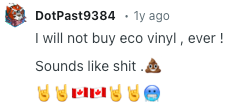
But no matter where you go, or what interview you’re reading, you find something like “but the really good thing is that they sound almost identical to the best conventional PVC black vinyl pressings.” Realistically, 99% of us can’t really tell the difference; we just want to say we can. Such is the pretentiousness of this hobby from time to time.
It’s hard to balance out this idea of being more green, while the same artist will put out 10 variations. And should it be the job of consumers to drive the manufacturers in a specific direction?
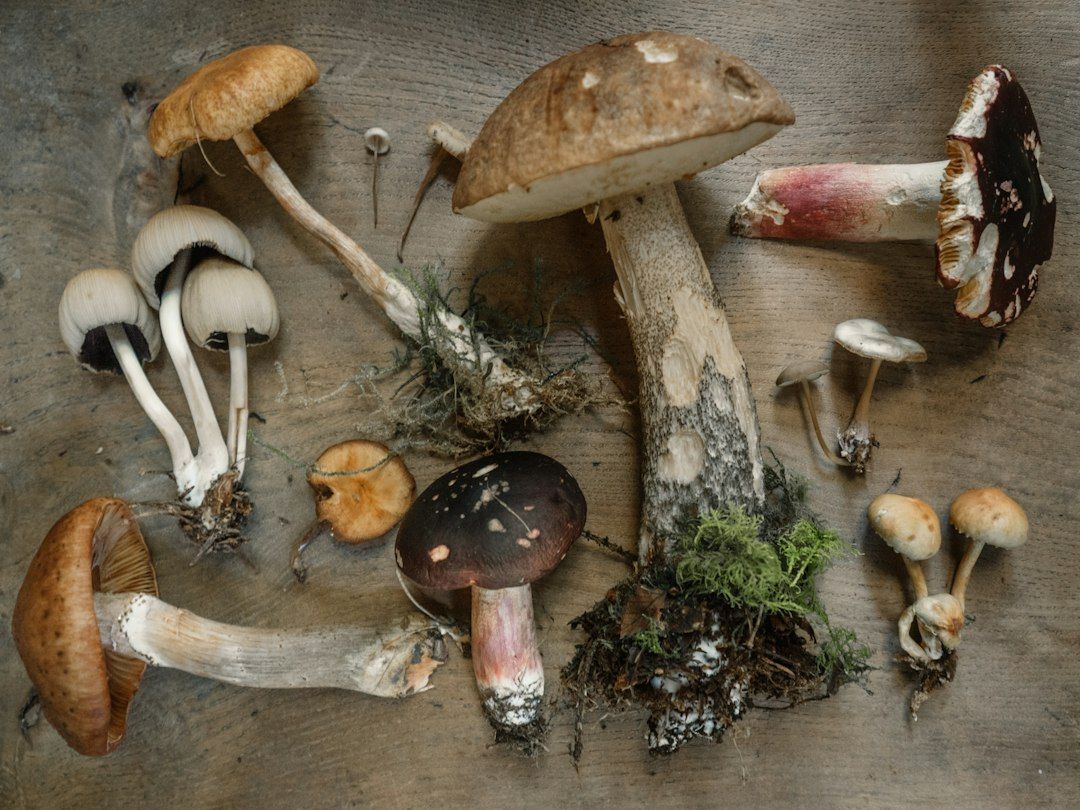
Music Made of Mushrooms
If you are wondering where the mushrooms came into it, we were looking at the Brian d’Souza (Auntie Flo) Mycorrhizal Fungi album. It featured a scratch-and-sniff sleeve that smelled like a damp forest, and the sleeve is easy to compost. The record itself? Very cool “bioluminescent” feature, aka UV-reactive paint that mimics how some fungi behave. The biosonification of 4 types of mushrooms made the soundscape. Lovely.
All of that, yet it is on regular old vinyl. Lion’s Mane is pretty good.

If you click it, you’ll be taken to Bandcamp, and you can listen to a sample.
We can make music with mushrooms, but can’t market or R&D our way to sustainable records.
We’re in this strange paradox, where the chronically online are craving a 2016 or a 2006 they’ve never known (anemoia is the word for that), championing vinyl and CDs as the way forward, buying en masse and all variations. Where, for many of us (older/much older), it’s recollecting, or we simply never stopped in the first place.
So what is the move here? What is the sustainable option?
It’s actually the simplest thing of all. Listen to your records. Your job becomes to consume what you have invested in (at least 27 times, mind you). Own what you love, love what you own. Play it until the grooves are barely holding on. If ‘we’ are going to insist on physical media, we need to stop treating them like precious artifacts and let them see a needle. Regardless of whether they are made from cooking oil, leaves, or potato starch.
We went looking at eco-friendly vinyl, compostable records, and whether any of it actually sounds as good as the real thing. Spoiler: Reddit is divided. If the vinyl conversation is your thing, Vinyl Is The New NFT is where we got into the collecting obsession that started all of this.
See you next Thursday,

Log in or subscribe to comment