
Hello You
Last week, we were looking at the tactics used to maximize how much a small subsect of fans will spend on an artist. If you missed it, Extractive Era.
This week, we’re seeing a lot of SUNO and lawsuits in the headlines. It got us thinking, do our 48 streams put us at risk?
Are you ever too small to get sued?
If that isn’t your thing, scroll to the bottom for some new music.
Did we mess up? →

Photo by James Owen on Unsplash
SongsBrew Editorial
Is AI music ever ‘clean’?

Gif by theoffice on Giphy
Let’s start with one of the biggest questions: when you use SUNO, for example, to make AI music, are you ever creating something totally unique? A multi-million dollar question. Musically speaking, maybe. Legally speaking? No. To understand that, we need to look at how things like Suno, Udio, and Google’s Lyria work.
Suno works kinda like ChatGPT. It uses a combination of technologies to ‘create’ the music. So, starting with the Generative AI model, Suno’s is proprietary, so it comes down to guesswork as to exactly what and how they are doing it. It is trained on massive libraries from record labels, and it also uses waveforms. To predict the next element, it uses a Transformer model; these match your prompt. The Diffusion model generates the audio in HiFi.
And as for understanding prompts, it recognizes words relating to music, like lofi, bass, guitar, 80s, and so on. They “memorize” millions of details from millions of songs, and replicate them where it makes sense to do so based on predicting what should happen next in the song you are building. Suno had two interesting neural models, Bark and Chirp, one of which handled realistic vocal melodies, and the other handled the instrumentation. They’re using more unified models now with the v3.5/v4.
You type a prompt. “Uplifting electronic. Female vocals. Morning coffee.” Suno’s pipeline kicks in. A text encoder parses the words. A sequence model decodes them into melody, harmony, and rhythm. Then a neural vocoder renders the waveform.
The result is a full song with lyrics and instrumentation. The whole process takes 60 seconds. It’s quick. It’s interactive. And in our experience, you get two tracks generated. For each prompt. From our previous newsletters, you’ll know we used extended prompts and got much better results, too.
But is it yours? Is the one we made ours? Can we get sued?
Udio and Suno have spent much of their time from conception until now fighting off the record labels and settling with others. While users can pay a subscription fee to use their licensed model, where you can get a commercial license, you’re protected from pretty much nothing. Neato.
The reason that you and we are still fair game for a good suing is that the US Copyright Office is holding firm to its position on AI-generated music. You can’t register it, you can’t stop someone else from taking it, unless it has a meaningful human authorship. With Lyria, it caps out at 30 seconds, and it watermarks the audio with SynthID, designed to only ever be music in a clip, never a song for the charts. Compliant, safe, but oh so meh.
The T&Cs for most AI-generation music platforms will have an indemnity clause - basically, it is never them, it is always you. We reported many moons ago that some of Udio’s defense was that they just built the tool, and the users are responsible for how they use it.
Sometimes they mimic too hard; in all of their learning, the Transformers might spit out a bar-for-bar copy of a hugely famous artist. You might not notice it, and upload it as usual. Next thing you know, Drake’s team is issuing a DMCA and/or a lawsuit to whoever uploaded the music to the streaming platform.
Either way, unless there is a lot of human influence over the output, 100% AI-generated tracks are never clean.
The Melting Pot
Universal and Warner have both made agreements; artists can opt in, and if you use their ‘vibe’ in a track, they can get a cut of the cash. Sony Music, however, is still in the trenches. So currently, anything too Sony-sounding will get you in hot water.
Your commercial license is basically a paper shield. Sure, you can put your song out in the world. Sure, you can make money from it. But if an artist and their team knock on your door due to copyright infringement? It has nothing to do with the generating platform, and your paper shield will be useless. So yes, you can get sued for less than 48 streams, actually.
While Suno and Udio are shaking hands and making peace treaties with the majors, you’re always going to be standing on a trapdoor. They built the noose; we just hang ourselves with it.
What better time for an update on our own AI experiment? (You can refresh yourself on this one here: Is AI Music Hard To Create?)
Since our last update, the track was attached to a post on Instagram, which hasn’t been reflected in the analytics yet. It has, however, come up on TikTok too.
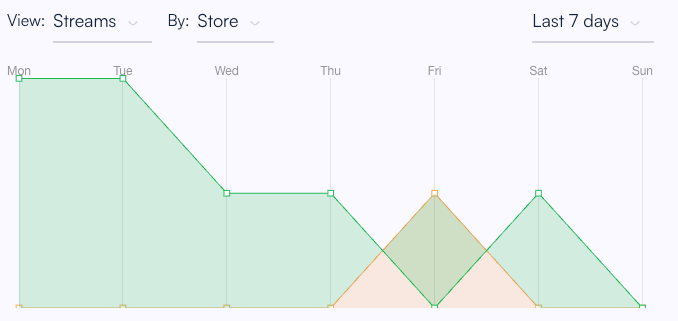
A total of 47 streams on Spotify and 1 (the orange triangle) on TikTok since the 1st of March. It might not sound like a lot, but imagine a room filled with 48 people listening to what you have to say. And all with the added bonus that you might get paperwork telling you you’re being sued for millions.
Here’s where it gets interesting: after 100 streams, Spotify can use SynthID or check the content credentials and know which AI model made it, and if you used an unlicensed prompt. An invisible fingerprint. You need 1,000 streams to get paid, but just 100 can get you in trouble.

Giphy
New Stuff
On our travels on the internet and through a submission portal, we get and find a lot of new music and artists. To that end, we recently launched RADAR. Where we share new music and artists, you’ll find it on Instagram and on the SongsBrew website.
Here are some new artists we have featured recently, tap images to open Spotify:
For fans of Fall Out Boy & Panic! At The Disco. Introducing Fluorescents.
Image: Spotify.
For fans of Alicia Keys & Norah Jones. Introducing Becky Sikasa.

Image: Spotify.
For fans of Devendra Banhart. Introducing Today and Today and Today.

Image: Spotify.
If you like psychedelic DnB/Jungle and Shamanic chants. Introducing Charlie Power.
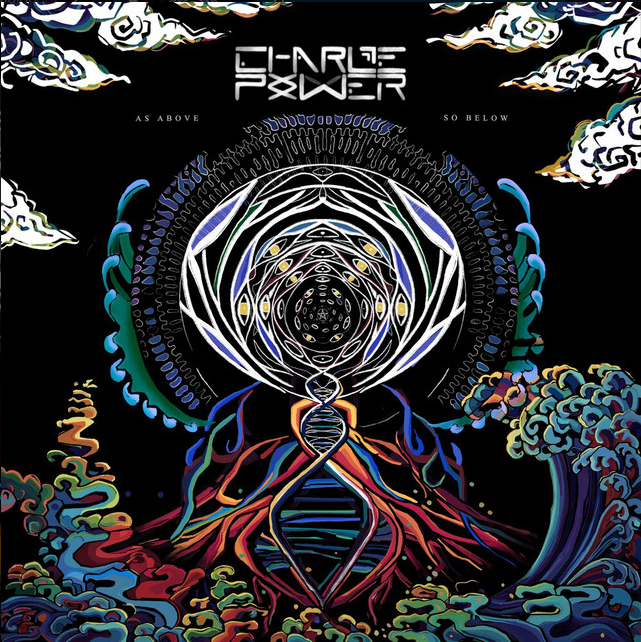
Image: Spotify.
This week’s favorite: Vibe Chemistry, Elro, Local, JayaHadADream, Lupole x Dixon Beats with Burst My Bubble (Remix). UK Grime, drillstep, dub, garage vibes. Enjoy.
Image: Spotify.
Until next time,



Log in or subscribe to comment