


If Radiohead had released it, it would have been streamed by millions already.
IS STEFFAN JAYES WHITE A REGULAR ON OUR PLAYLISTS?
No.
When it comes to reviewing, it becomes very easy to just select music to showcase that will have a huge, hungry audience waiting for it.
But some of the SongsBrew team are lovers of the niche, of the stuff no one else has. And the question then becomes - well, if no one else has it, or is listening, maybe there is a reason.
Is the composition something that hasn't been done before? No. But that doesn't change the fact that, while it is light and simple, it works well. The piano keeps the track pushing forward. The vocals at first listen sit weird, but the second time around, you're thinking... Nick Cave and Thom Yorke's vocals are often rubbish. And yet, they have your whole ear. And our newsletter readers know for sure we enjoy the odd more than the regular.
It opens up slowly and has something akin to wind chimes or a triangle tinkling away that strips back pretty quickly. We still can't help but believe this is a track that would easily fit in a movie, during a sad, dramatic moment… it is a sync waiting to happen.
Why did we choose this to share with you?
It has an unusual beats-per-minute count and an unusual combination of depths. Because the vocals are far from pristine and overproduced, maybe 'cause it has that set back voicemail styling we are a sucker for.
And maybe because it looks like this:
Did we love it the first time we heard it? No, but we had to listen again. That is where music and its being good or bad are wholly relative and conceptual.
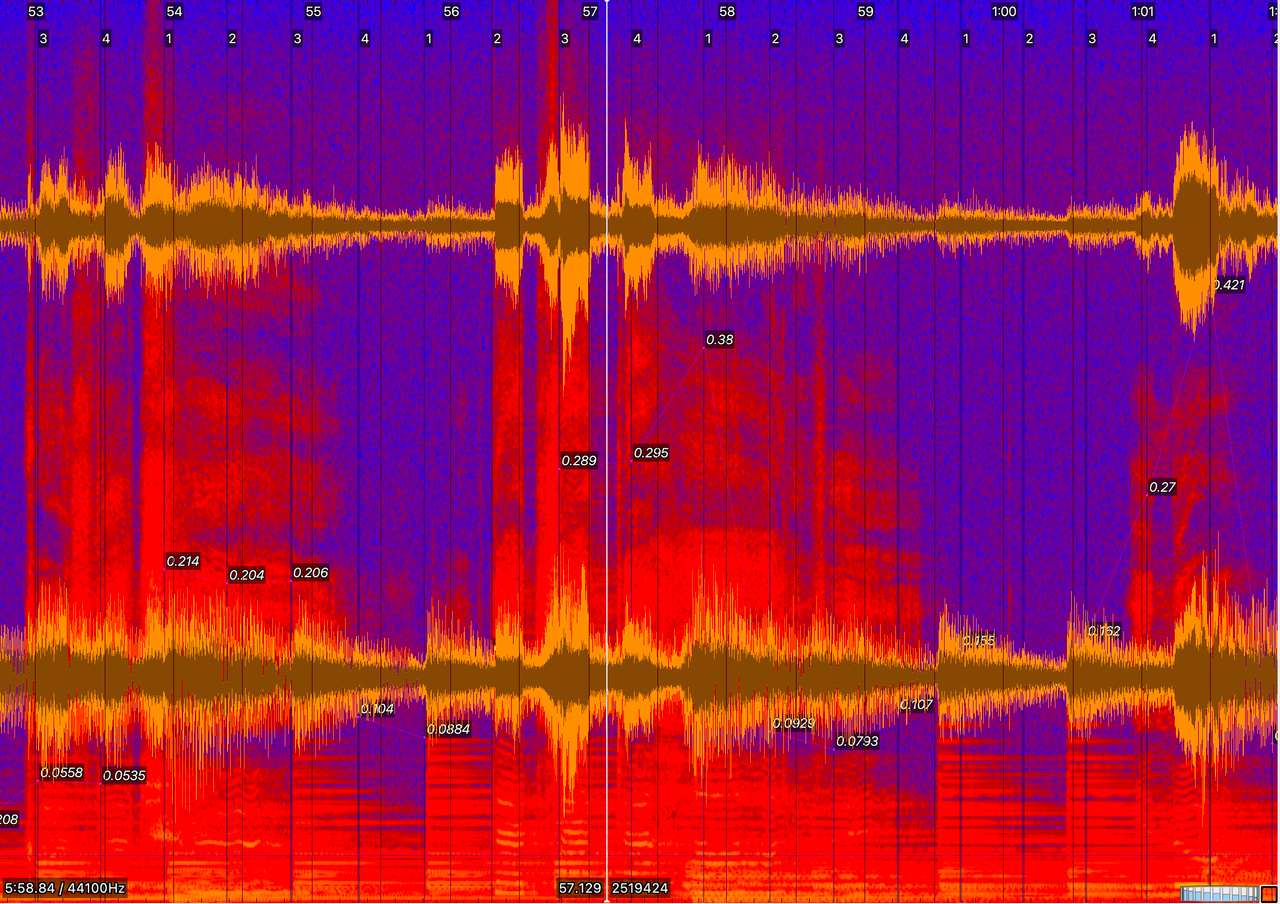
The image above is a spectrogram: frequency on the vertical axis, time running left to right, color showing energy. Red is loud, blue is quiet. This is the track between 53 seconds and 1:01.
The waveform layer (the orange/brown band in the middle) shows the actual amplitude. Notice it's relatively consistent and flat for most of this section, then at the 57-second mark, there's a significant spike: a loud transient hit, the biggest event in this window. Then it settles back. A structural moment: a beat drop, a new element entering, a deliberate dynamic hit.
The tempo curve is all over the place, values jumping from 0.0535 up to 0.421. That's a huge variance. The beat tracker is genuinely struggling here, which tells you this track has either very sparse percussion or the rhythmic elements are buried deep in the texture. The plugin is latching onto texture transients rather than a real beat grid. There essentially isn't a traditional pulse to follow... except there is.
That's just a few seconds.
Here is the full track:
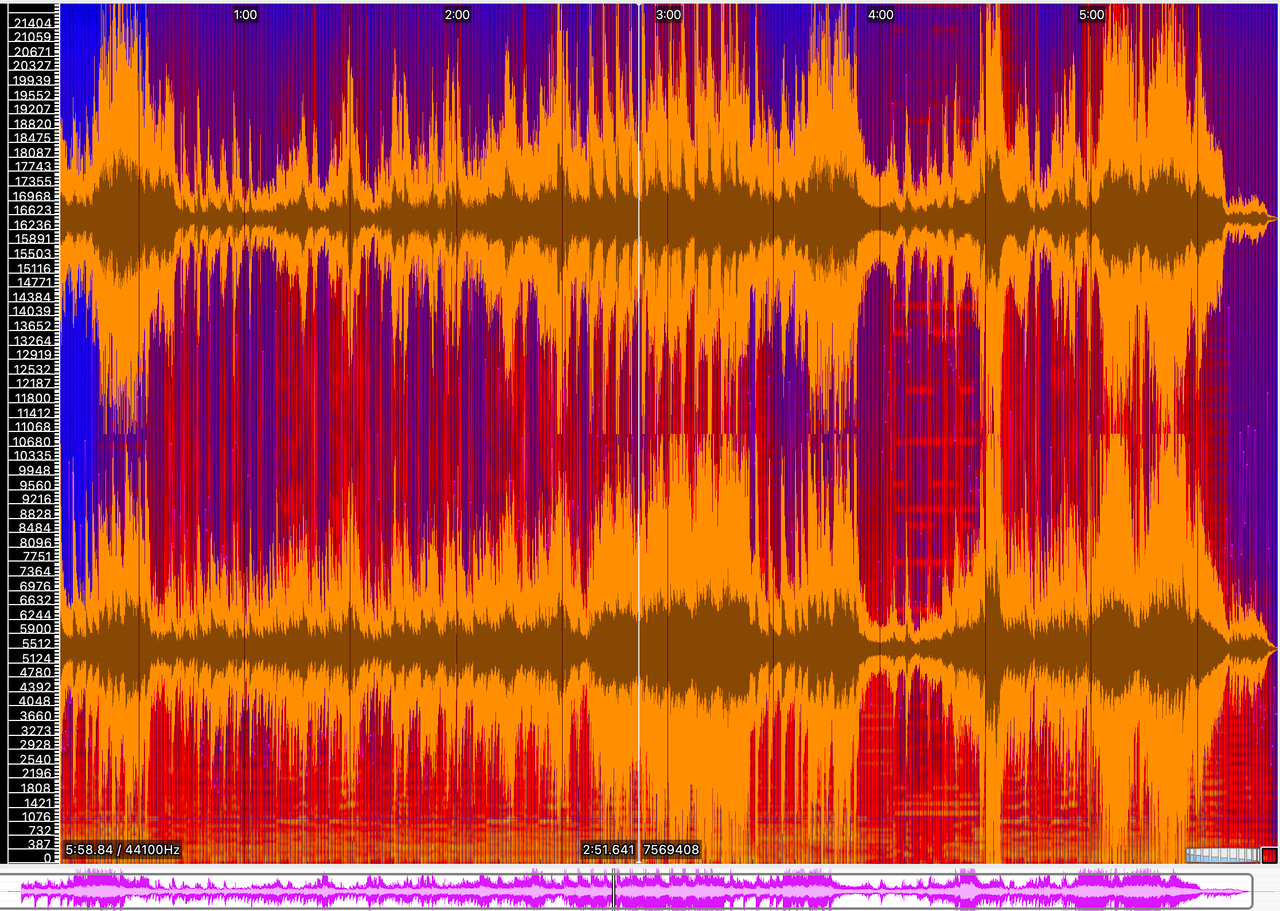
The air band (12,000-18,000Hz) starts almost at zero in the first 30 seconds (0.0028) and builds progressively, peaking in the final two sections (0.3864 at 300-330s). The track doesn't arrive with its full frequency range. The top end is introduced gradually and is most present at the end, not the middle.
The 250-500Hz range is the most consistently active band across the whole track, peaking at 24.2 at the 3:00-3:30 mark. What the spectrogram showed as relatively sparse in that range is misleading. It's the dominant frequency zone throughout.
RMS hits 0.2338 around 3 minutes, the highest point on the track. Then it drops sharply between 3:30 and 4:00 (0.1689), before a second rise in the final two minutes.
Stereo correlation of 0.581 is genuinely wide. Not mono-leaning. That symmetry in the spectrogram is real width, not just visual balance.
The track builds its high-frequency content almost entirely in the back half, while the low-mid dominates throughout. It's a track that gets brighter as it ages rather than darker. That's the inversion of how most ambient tracks work.
All of that to say, we're not sure why we like it, we just do. Look at the image as you listen, and it'll make sense to you too.

5/5 of confusion.



Log in or subscribe to comment